LinkedIn posts vs DMs for founder network growth
Social Media Marketing
Build visibility with LinkedIn posts, then DM engaged people to turn familiarity into calls, hires, or investor conversations.

If I want more founder network growth on LinkedIn, I don’t pick posts or DMs. I use both - but in order.
Here’s the short answer:
Posts help more people know my name.
DMs help me start one clear conversation.
Posts work best for reach, discovery, and trust over time.
DMs work best for targeting, privacy, and moving to a call.
The best flow is simple:post first, then DM people who show interest.
That matters because most people do not reply on first contact. Many watch first. They read, scroll, visit a profile, or react later. In B2B, it often takes multiple touchpoints before a meeting happens, and LinkedIn content can help create those touchpoints before outreach starts.
If I’m choosing between the two, I can keep it simple:
Use posts when I want visibility across second-degree contacts
Use DMs when I want a reply from one person
Use both when I need public proof before a private ask
The core idea: posts make me familiar, and DMs turn that familiarity into action.
Quick comparison
Criteria | LinkedIn Posts | LinkedIn DMs |
|---|---|---|
Reach | High | Low |
Discoverability | High | Low |
Trust building | Slow, over time | Faster, if context exists |
Targeting | Broad | Exact |
Personalization | Low | High |
Privacy | None | High |
Best next step | Profile visit, follow, comment | Reply, call, meeting |
Time cost | Lower per person | Higher per person |
So if I’m a founder trying to meet buyers, hires, or investors, I don’t treat these as substitutes. I use posts to warm the room, then DMs to talk to the right person.
LinkedIn Posts vs DMs: Strengths, Limits, and Tradeoffs
Posts build trust before the first conversation
When a founder shares operating lessons, market takes, product views, or hiring standards on a steady basis, second-degree contacts start to recognize the name before any outreach begins. That recognition is the asset.
A lot of prospects don’t reply right away. They watch quietly for weeks or even months. Posts act as a signal that warms people over time. As Matt Huang, Founder, Forj Media, puts it:
"Every post you publish is a signal. Not everyone who sees it will act immediately. But the right people will bookmark your content, watch from a distance, and decide that when they're ready to have a convo, you're the one they'll go to."
That only helps if you know who you want to move and what you want them to do next.
Feature | Advantage | Limitation |
|---|---|---|
Reach | Can reach second- and third-degree contacts through the feed | Depends on audience size and posting cadence |
Discoverability | Helps potential buyers find you through relevant insights | Requires consistency to stay visible |
Trust Formation | Builds long-term authority and warms the audience | Passive; doesn't guarantee a direct response |
Targeting | Broad enough to reach a niche audience | You can't control exactly who sees each post |
Conversion | Creates context for future one-to-one conversations | Usually needs a DM or follow-up to move forward |
DMs open targeted conversations and create clear next steps
Posts reach broadly. DMs do the opposite. They’re a precision tool.
But they only work when three things are in place:
a defined recipient
a clear reason to reach out
one specific ask
A good DM points to shared context, gives one reason for the message, and ends with one simple next step. What hurts reply rates is generic copy that could have gone to anyone.
This matters most when you’re reaching out to a second-degree contact, buyer, hire, or investor.
Feature | Advantage | Limitation |
|---|---|---|
Personalization | Can reference specific shared interests or content | High time cost per message |
Privacy | One-to-one environment suited to sensitive business asks | No viral potential or secondary reach |
Targeting | Reaches the exact decision-maker you want | Limited by platform outreach caps |
Response Likelihood | Strong when the recipient has already engaged with your content | Easy to ignore if sent cold |
Relationship Depth | Can move quickly to a call or meeting | Feels transactional when relevance is weak |
Why both channels fall flat without context
Posts without a clear point of view are easy to scroll past. DMs without a clear reason to land in someone’s inbox feel like an interruption. In both cases, the problem is the same: lack of relevance.
A founder who posts vague updates isn’t building recognition. A founder who sends a message that could have been copied and pasted to 500 people isn’t building a relationship either. Both channels work when the message matches the relationship. That context shapes which channel should come first.
Which Channel to Use Based on Your Network Goal
If posts build awareness and DMs drive action, the right channel comes down to the outcome you want. Match the channel to the next step: posts build familiarity, while DMs open a conversation.
Second-degree contacts and buyers
Posts are a strong way to warm up second-degree contacts. When you keep sharing your views on market problems, product decisions, or lessons from customers, people start to know your name before you ever reach out. That matters. The post sets the stage, and the DM begins the actual exchange.
But timing matters. Send the DM only when there's a clear trigger, like a comment, a profile visit, a mutual connection, or a direct signal of interest. Without that context, a DM to a second-degree contact is just noise.
Criteria | LinkedIn Posts | LinkedIn DMs |
|---|---|---|
Awareness | High: Reaches second-degree contacts through the feed | Low: Limited to one-on-one interaction |
Trust | Built over time through consistent, relevant content | Built quickly through personalization or voice notes |
Targeting | Broad, algorithm-driven | Precise, individual selection |
Likely Next Step | Profile visit, follow, or comment | Discovery call or meeting booking |
Talent and investors
The same idea applies when you're hiring or fundraising. A candidate who's thinking about joining your company wants to get a feel for your leadership style and mission. An investor wants to see how you think and whether you understand the market. Posts help with both. They lower skepticism at scale by showing your mission, leadership style, and market credibility before any direct exchange starts.
DMs move a specific hiring or fundraising discussion forward. That includes a targeted note to a senior engineer, a warm follow-up after a fund partner engages with your content, or an update to an investor you've already met. Those belong in DMs. And if the topic is sensitive, like fundraising details or hiring terms, a one-on-one message is the better place for it. Since direct outreach is limited, each DM needs to be tightly focused.
Criteria | LinkedIn Posts | LinkedIn DMs |
|---|---|---|
Authority | High: Signals mission, leadership style, and market credibility | Moderate: Relies on the strength of your profile and prior context |
Personalization | Low: One-to-many by nature | High: Tailored to a specific role, portfolio, or individual |
Confidentiality | None: Publicly visible | High: Better for sensitive conversations |
Relationship Progression | Passive: builds familiarity over time | Active: advances one clear next step |
Once the right people are warmed by posts, the next move is a DM with context. That's why the best founder workflow starts with a post and ends with a targeted DM.
The Founder Workflow: Post First, Then DM With Context
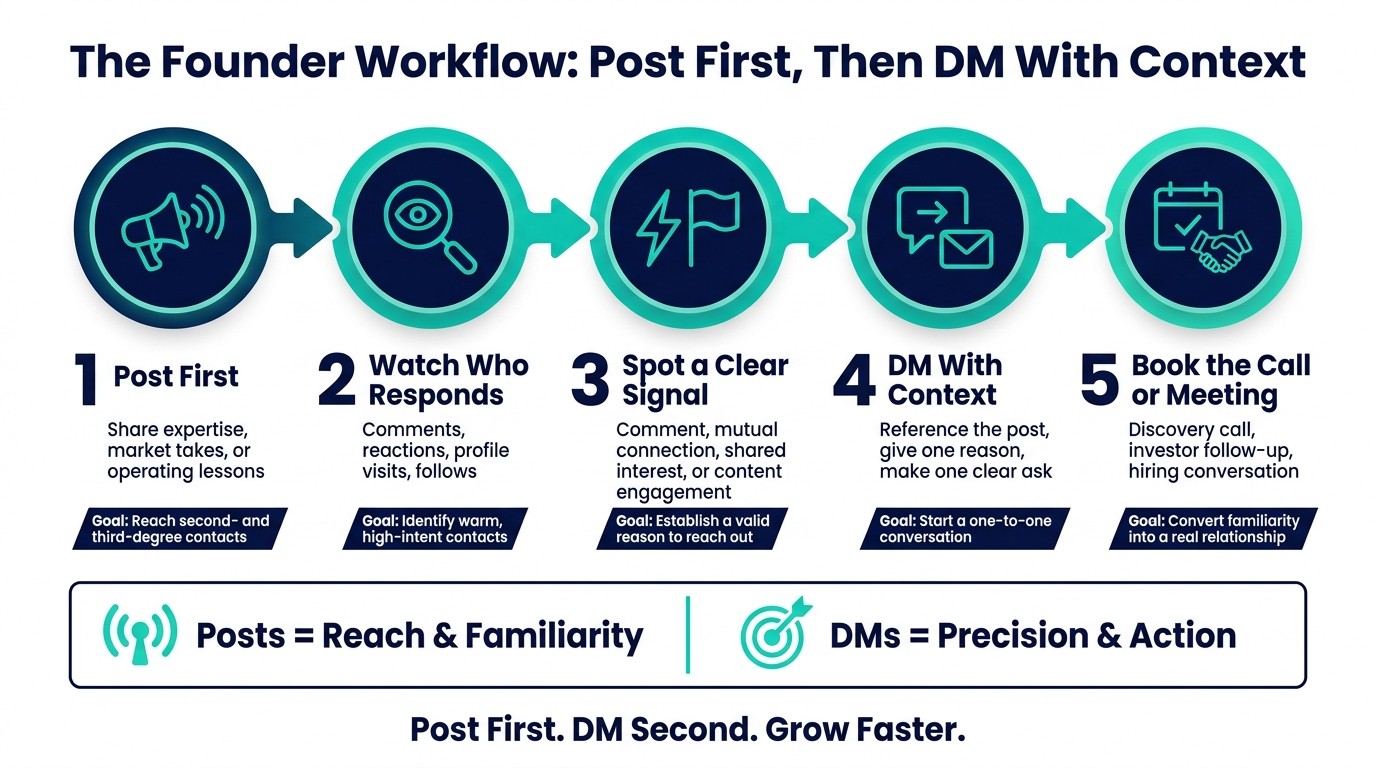
LinkedIn Posts vs DMs: The Founder Workflow for Network Growth
A simple sequence from visibility to conversation
Start with the post. Then DM the people who engage.
The idea is simple: publish content that shows your expertise and point of view, then pay attention to who responds. Those people are your best first DM targets because they already know who you are. You’re not starting from zero.
Use the post as the reason for the message, then make one clear ask. That’s what turns a post into the setup for a better DM.
If someone has already shown intent, DM them right away. If not, the post-first sequence usually works best when you’re building familiarity from scratch.
How to choose faster
Once the goal is clear, picking the channel gets much easier.
Use posts when the goal is discovery or reputation.
Use DMs when the goal is a specific conversation.
Use both, in that order, when public credibility needs to come before a private ask.
Voice notes can work especially well in DMs. They feel warmer than text and can carry more context in 20 seconds than a written message. Use them when you want outreach to feel more personal and close - not when you’re trying to send a high number of messages.
How a content system supports this workflow
This post-first approach only works if you post on a steady basis.
Content builds trust and authority over time. That’s what helps your DMs feel like warm follow-ups instead of cold outreach. Forj Media helps founders keep a consistent LinkedIn content system.
Conclusion: Use Posts for Reach, DMs for Precision, and Both for Real Network Growth
That sequence is the whole point of the framework: earn attention in public, then move the right people into a private conversation. Posts and DMs do different jobs. Posts create reach. DMs create movement. Posts make you familiar. DMs turn that familiarity into a live conversation.
A lot of founders lean too hard on just one side. Some post all the time but never follow up. Others send cold DMs with nothing in public to support them. Both approaches leave a lot on the table.
Use posts to build familiarity and make your name recognizable. Then use DMs to turn that attention into action. Post first, DM second. That’s how you get warmer second-degree contacts, faster buyer conversations, stronger talent outreach, and more credible investor follow-up.
FAQs
How often should founders post before sending DMs?
Prioritize posting quality content to warm up your audience before you send direct messages. Don’t lock yourself into a rigid posting calendar. Start with a simple baseline of three posts per week, then adjust based on engagement.
A mix of authority, personal stories, and growth insights helps build trust. It gives people a reason to know your name before you land in their inbox.
When it’s time to reach out, send fewer, more personalized messages to active second-degree connections who’ve already shown intent.
What counts as a strong DM trigger on LinkedIn?
A strong LinkedIn DM trigger comes down to two things: personalization and clear intent.
Generic outreach usually falls flat. People can spot a copy-paste message in seconds. A better move is to contact second-degree connections who are active and have already shown some interest, like engaging with your content.
That small signal matters. If someone liked, commented on, or shared your post, the conversation doesn’t start cold. It starts with context.
Voice notes can also help you stand out. They often feel more human than plain text, and they can build trust faster. Instead of sending a long message, you can use a short voice note to make the interaction feel direct and personal.
From there, guide the exchange toward one clear next step, such as booking a call.
Should I use the same approach for buyers, talent, and investors?
The goal stays the same: build trust. But the way you do it should fit your audience and your goal.
Use public content to warm up buyers, job candidates, and investors. The idea is simple. Show what you know, and share personal stories over time. That steady mix helps people get a feel for how you think and what you stand for.
For direct outreach, skip generic, high-volume messages. They usually feel cold and easy to ignore. Instead, treat each new connection like scarce capital. Qualify the fit, personalize the message, and take time to nurture the relationship.
For high-impact outreach, voice notes can build trust faster than text. Hearing someone’s tone adds a human layer that plain words often miss.