Founder Voice Framework for Busy CEOs
Social Media Marketing
Use daily work as source, move ideas through fast drafts and limits, set clear voice rules, and keep CEO review under 30 minutes/week.

If you want to post as a founder without losing hours each week, keep the system simple: collect ideas from your daily work, turn them into drafts fast, limit review rounds, set clear voice rules, and let one person run the process.
Here’s the short version:
Use your work as the source. Pull post ideas from customer calls, product debates, hiring calls, company data, and market shifts.
Keep idea capture simple. Use one tool only - like Slack, voice notes, or Apple Notes - and log the topic, your take, and why it matters.
Use one path for every post. Note → brief → draft → review → publish.
Limit CEO time. The target is under 30 minutes of CEO feedback per week.
Split review by risk. Low-risk posts can move in under 24 hours. Higher-risk posts may need 48–72 hours and extra review.
Stop endless edits. Too many rewrite rounds drain time and flatten the founder’s point of view.
Write down the voice. Define how you speak in plain English, plus a “say this, not that” list to cut filler.
Let the team do the work around the idea. The founder owns the opinion and final voice. The team handles drafting, publishing, and tracking.
Give one person full ownership. Without a driver, the process slips.
A few numbers stand out: 81% of executives say a visible CEO shapes company reputation, and teams like Clay showed what steady exec posting can do, with about 6 million LinkedIn impressions in Q2 2026 on a $0 paid budget.
Bottom line: I’d treat founder content like a light weekly system, not a writing project. That’s how you stay visible without turning LinkedIn into another full-time job.
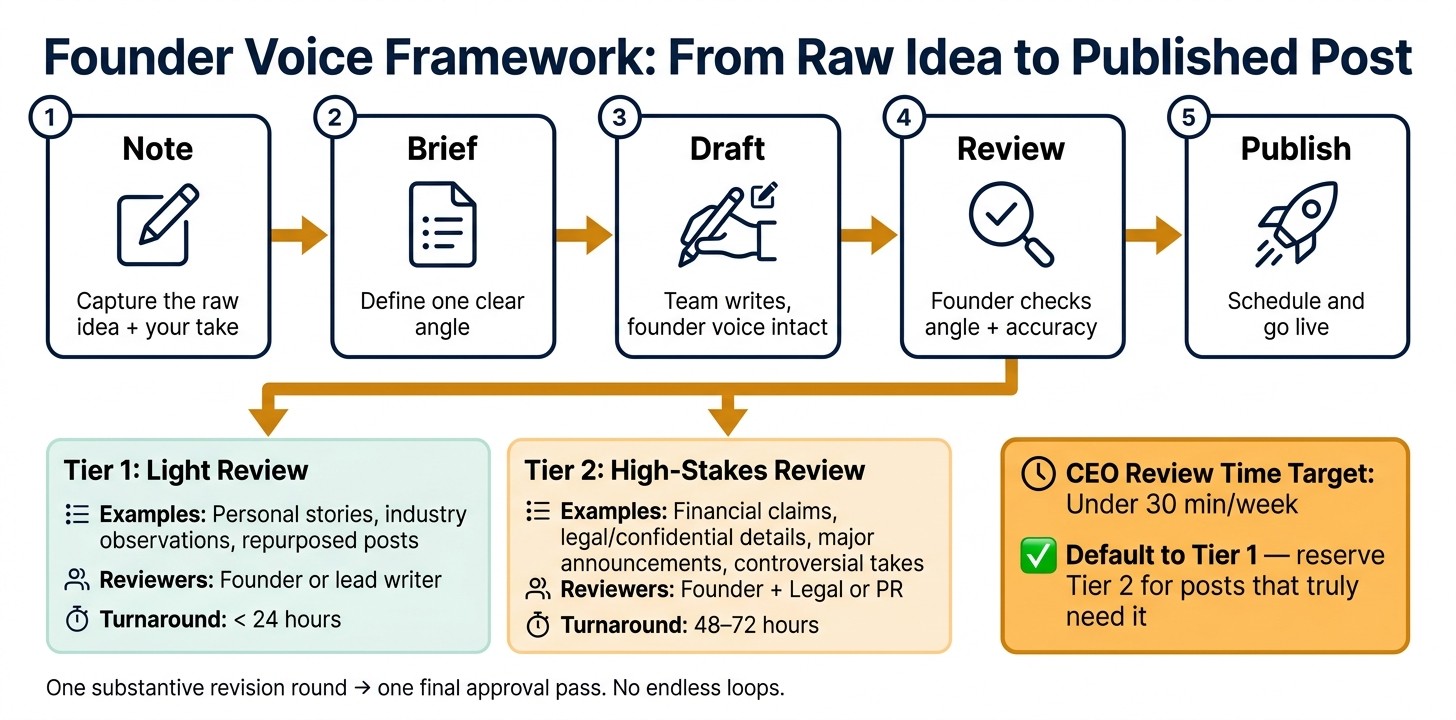
Founder Voice Framework: From Raw Idea to Published Post
1. Build a low-friction idea intake system
Pull ideas from the meetings, calls, and decisions already on your calendar. The goal isn't just to log the topic. It's to catch the opinion behind the moment.
Start with raw material first. Drafting comes later.
Five reliable idea sources already in a CEO's week
You already have five repeatable idea sources in your week: customer objections, internal data, industry shifts, internal strategy debates, and product progress, launches, and experiments.
Customer objections are one of the easiest places to start. If a prospect asks the same question for the third time, that's a post.
Internal data can work just as well. A post built on internal data can beat generic commentary fast.
Pick one capture method and stick with it
Choose one capture tool - Slack, voice notes, or Apple Notes - and use that same tool every time.
The tool itself matters less than consistency. If you switch systems every few days, ideas slip through the cracks.
Capture the context while it's still fresh. Right after the meeting, write one line: what happened, what you think, and why it matters.
That's your raw material. Everything else gets built from there.
Turn one conversation into several post angles
One founder update or weekly check-in can lead to more than one post.
A product debate can become a clear point of view. A hiring decision can turn into an operating principle. A customer pushback can sharpen your take on what the market gets wrong.
One conversation can generate multiple post angles. Each angle should show how you make decisions, not just what happened.
Those raw angles then move straight into the draft flow in the next step.
2. Move raw notes to published posts with a fast review path
When a meeting, sales call, or product decision turns up a useful angle, push it through the same path every time: note → brief → draft → review → publish. The point is simple: build a fast system that keeps the founder’s voice intact without dragging the CEO into every small edit.
A simple draft flow from note to final post
The brief is what protects founder voice. It takes a rough note and turns it into one clear angle tied to the customer objection or problem underneath it. If the note is still fuzzy, add 3–5 angle options to give it direction.
That one step matters more than it seems. It’s the difference between a post that sounds like the founder and one that reads like generic advice.
Two review tiers based on content risk
Not every post needs the same level of review. A personal story or an industry observation can usually move with a quick check. But if a post includes financial claims, confidential details, controversial hot takes, or a major company position, it needs a tighter review path.
A simple two-tier setup keeps things moving without being sloppy:
Review Tier | Examples | Reviewers | Expected Turnaround |
|---|---|---|---|
Tier 1: Light Review | Personal stories, industry observations, repurposed high-performing posts | Founder or lead writer | < 24 hours |
Tier 2: High-Stakes Review | Financial claims, legal/confidential details, major company announcements, controversial hot takes | Founder + legal or PR | 48–72 hours |
Keep Tier 1 as the default. Save deeper review for posts that actually need it, not for every single draft that comes through.
Set a revision limit to keep the process moving
Revision loops are where founder voice starts to fade. Matt Huang, Founder & CEO of Forj Media, says it best:
"The problem was too many revision cycles. Some clients go back and forth 5-6 times on a single post, which eats bandwidth I don't have."
A simple rule helps: allow one substantive revision round, then one final approval pass. The founder’s job is to check accuracy and point of view, not tweak every sentence.
Speed helps, but only if the draft still sounds like the founder.
3. Set tone guardrails so every post sounds like the founder
Once the draft process is set, the next problem is voice drift. Posts may look polished, but they start to sound like everyone else. The fix is simple: put a few clear guardrails in place so the founder’s point of view stays on the page.
Write a plain-English voice guide
A voice guide should answer one thing: what does this founder actually sound like?
Start with three words. In this case: direct, candid, useful. Then spell out what the voice avoids: inflated claims, jargon, and vague language.
But don’t stop at word choice. A good voice guide should also show how the founder thinks, makes decisions, and pushes back. That’s the part that turns a basic style doc into something a writer can use.
Matt Huang, founder of Forj Media, puts it this way:
"He's not afraid to be controversial or be brutally honest... it gives him credibility as someone who doesn't just say what he thinks people want to hear, but what they NEED TO KNOW."
Matt Huang, Founder, Forj Media
That kind of trait is usable. A writer can look at it and know what the post should sound like.
Build a 'say this, not that' language list
A plain language list helps drafts stay specific and grounded. It also cuts down on the usual corporate filler.
Say This (Founder Voice) | Not That (Corporate/Generic) |
|---|---|
"We saved 12 minutes per task using [Feature]." | "Our tool makes your team more efficient." |
"A customer told me: 'This is the first time I've felt heard.'" | "We have high customer satisfaction ratings." |
"I disagree with the industry standard of [X] because..." | "We follow best practices to ensure quality." |
"Here is the exact mistake that cost us $50k." | "We are constantly learning and growing." |
"I debated this for an hour with [Name] from [Company]." | "Many experts agree that..." |
With a list like this, the writer doesn’t have to play mind reader. They can make sharper choices from the start.
Allow tone shifts by context without changing core voice
Founders don’t talk the same way in every setting. And that’s fine. A product update should not sound like a hiring post. A hiring post should not sound like a hard industry opinion.
The voice stays the same. The emphasis changes.
Situation | Tone Adaptation | Goal |
|---|---|---|
Product updates | Map to specific customer objections | Show utility |
Hiring posts | Speak directly to the engineers and designers you want to hire | Attract top talent |
Industry opinions | Use brutal honesty | Build credibility |
Tough moments | Use direct narrative | Frame the story |
Customer stories | Pull the exact quote or moment from the conversation | Make proof feel real |
When these rules are written down, a content partner can shift tone based on the situation without losing the founder’s voice. At that point, delegation stops feeling like a brand gamble and starts looking like a repeatable system.
4. Delegate execution without losing founder point of view
Once your tone guardrails are set, the next step is simple: decide who owns what. You want a clean split between the work only the founder can do and the work the team can move forward.
Decide what the founder must own and what the team can handle
The founder should own the ideas and the final voice. The team should handle execution.
Task | Founder Owns | Team Handles |
|---|---|---|
Ideation | Core ideas, original opinions, personal stories | Industry research, trend monitoring, news sourcing |
Creation | Pulling out the founder's point of view, final point-of-view sign-off | Drafting, headline testing, visual design |
Operations | Strategic alignment, sensitive judgment calls | Scheduling, publishing, image/video editing, analytics |
That split matters more than people think. If the founder tries to do every part, content slows to a crawl. If the team owns too much of the voice, the content starts to feel flat. The sweet spot is pretty clear: the founder brings the thinking, and the team turns that thinking into something publishable.
Use a lightweight weekly content rhythm
After ownership is clear, the next job is keeping the rhythm simple. A 30–45 minute weekly content interview works better than a writing session. Why? Because most founders are far better at talking through ideas than staring at a blank doc.
In that session, someone on the team should ask sharp questions, push back a little, and draw out the point behind the point. That’s usually where the post gets interesting.
"The interviewer should be more like a sparring partner than a yes man... focus on extracting the 'so what?'" - Matt Huang, Founder, Forj Media
Between sessions, the founder can drop in content moments as they happen: something from a meeting, a line from an email, or a thought after a Slack ping. The team then turns those raw inputs into drafts. The founder reviews the final angle and gives sign-off.
There’s one part that often gets overlooked: someone has to own the outcome. Not just the writing. The whole process. In Q2 2026, Clay's executive team generated approximately 6 million LinkedIn impressions with a $0 performance budget. Sarah Khasrovi, their Executive Brand & Content lead, ran weekly meetings and sent Slack nudges to keep executives on track.
"Getting executives to write will always be the bottleneck. You need to have someone who's borderline annoying to ensure this moves forward." - Bruno Estrella, Head of Marketing, Clay
That line is blunt, but it rings true. Founder-led content often breaks down for a boring reason: nobody is driving the follow-through.
When outside support makes sense
If your internal team can’t keep that cadence going, outside support can step in. Agencies like Forj Media handle LinkedIn strategy, storytelling, drafting, and content operations for founders who want to stay visible without rebuilding their week around content.
The founder still owns judgment. The team handles production. That’s usually the setup that keeps the point of view intact without turning content into another full-time job.
Conclusion: Keep the system simple, founder-led, and repeatable
Keep the system simple. Start with real moments from the day-to-day work, move them through a fast draft process, protect the founder’s tone, and hand off the execution. Each piece should feed the next. But this only holds up if the system stays light enough to run every single week.
The main risk is delay. Delay stacks up fast. A one-week slip can easily turn into a month.
Keep founder review under 30 minutes a week and give one person clear ownership of the workflow so nothing stalls.
The goal isn’t volume. It’s building a visible, recognizable point of view that stays part of the conversation without turning into a drag.
FAQs
How do I keep posts authentic if someone else drafts them?
Keep posts grounded in a clear voice process, not hunches. Start with a brand voice guide. Then use regular interviews or async prompts to pull out your point of view, stories, and customer insight.
That gives the writer enough direction to match your intent and reflect how you actually think. It also helps the draft sound like you, instead of a bland mash-up of generic ideas.
When it’s time to review, give specific feedback. Point to what feels off, what sounds right, and where the angle needs work. That keeps the process efficient without losing trust.
What kinds of posts need extra review before publishing?
Give extra review to posts tied to new or complex content pillars, especially when getting stakeholders on the same page matters. Those pieces often set direction, so it’s worth slowing down and checking them with care.
For routine posts, keep things lean. If every post goes through the same heavy process, the workflow can bog down fast.
It also makes sense to take a closer look at high-stakes topics, such as:
Sensitive industry news
Controversial takes
Major announcements that shape your brand voice
These posts can carry more risk, so they deserve more eyes before they go live.
Who should own the founder content process each week?
The agency team should handle the heavy lifting each week. That means drafting copy, writing video scripts, and running the publishing calendar.
The CEO should still stay in the loop, but the time ask stays light: about 20 to 30 minutes of review per week plus a biweekly live sync.
That setup keeps the founder’s point of view in the content without turning content into another full-time job. The agency takes care of research, design, revisions, and weekly execution.