7 LinkedIn Content Ideas for Tech Executives
Social Media Marketing
Seven repeatable LinkedIn post types for tech leaders: pick one goal, use specific proof, and turn real work into consistent posts.

If I want LinkedIn to help with hiring, investor interest, or sales, I should post about work I already did. The article’s main point is simple: the best posts for tech executives come from actual decisions, customer results, team moments, market takes, product updates, and hard lessons.
Here’s the short version:
I should pick one goal for each post: talent, investors, or customers
I should use specific proof, like numbers, tradeoffs, and outcomes
I should turn weekly moments into posts instead of trying to invent topics
I should lean on 7 repeatable post types:
leadership lessons from scaling a product
industry commentary
hiring and team stories
customer results
behind-the-scenes decisions
product vision updates
mistakes, pivots, and failures
The article also makes one point again and again: vague posts get ignored; specific posts get read. In one cited example, a founder’s posts helped him reach 77,000+ followers, while another result mentioned 1,900+ reactions and 170+ comments on a single post. Another client example claimed 700,000 monthly impressions with under 30 minutes per week of executive feedback.
Quick Comparison
Content idea | Main goal | Best angle | Time |
|---|---|---|---|
Leadership lessons | Build authority | Hard call and result | 45 mins |
Industry commentary | Shape market narrative | Debate-based opinion | 30 mins |
Hiring and team stories | Attract talent | Unexpected hire or team moment | 30 mins |
Customer stories | Support pipeline | Before/after with metrics | 60 mins |
Executive decisions | Signal judgment to investors | Why I made a hard call | 45 mins |
Product vision updates | Support pipeline and investor story | Demo with numbers | 60 mins |
Mistakes and pivots | Build trust | What failed and what changed | 45 mins |
My takeaway: if I want LinkedIn to work, I don’t need more ideas. I need to spot the post inside the work I’m already doing.
How Tech Executives Should Use This LinkedIn Idea List
Each idea ties to a clear business goal. Before you write, decide who the post is for: talent, investors, or customers. That choice should shape the angle, the proof points, and the format. In plain English, pick the idea based on the outcome you want.
Skip abstract leadership advice. Instead, talk about a decision you made and what happened next. As Matt Huang, Founder of Forj Media, puts it:
"The ones who scale content don't have more interesting lives. They're just better trained to see the content in what's already happening."
Write from a real moment, like a decision, an objection, or a challenge, and show what changed because of it. You don't need to invent ideas out of thin air. The better move is to notice the moments already showing up in your week.
Use text posts for quick lessons, carousels or documents for frameworks, and video for culture or team stories. Next, use the quick reference to match each content idea with the business goal it supports.
A Quick Reference for Matching Content Ideas to Business Goals
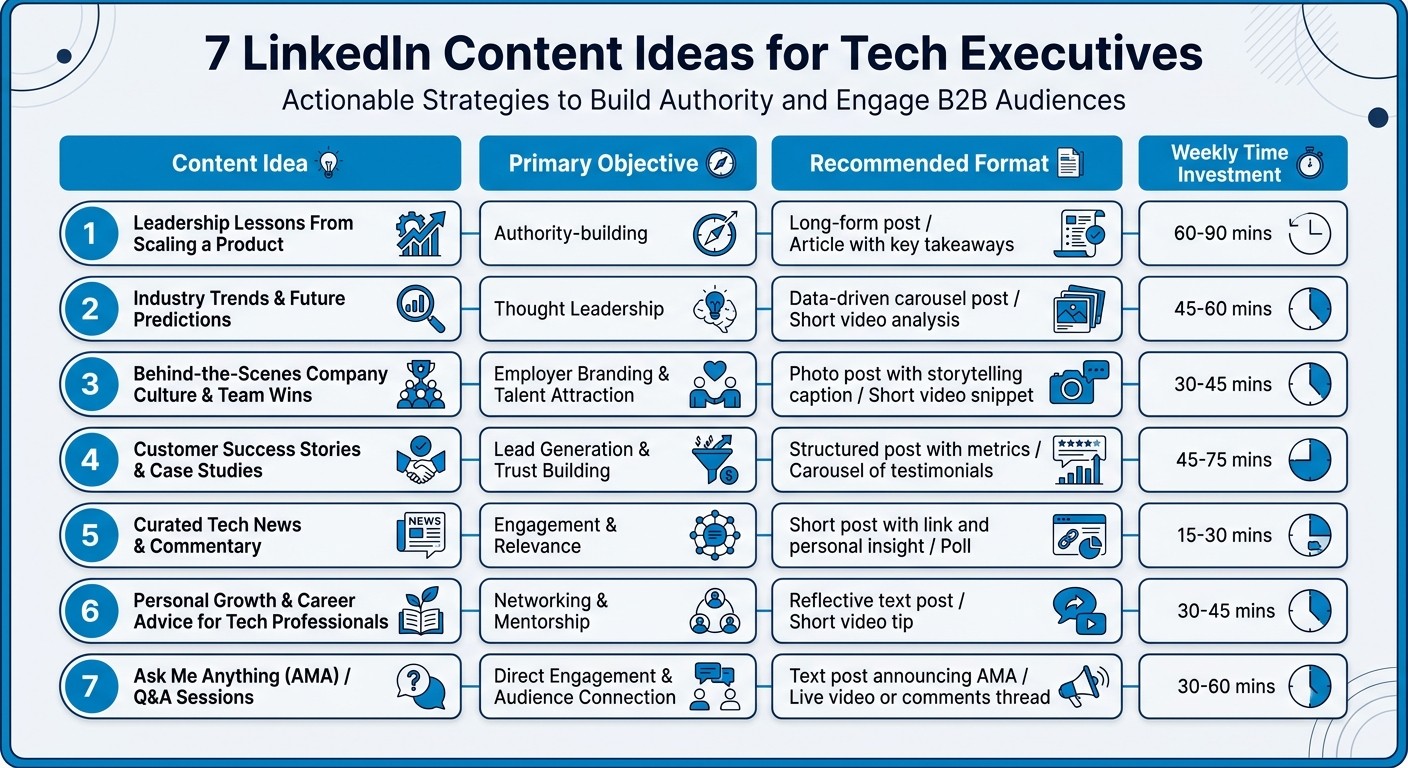
7 LinkedIn Content Ideas for Tech Executives: Goals, Formats & Time
Not every LinkedIn post needs to do the same thing. Some posts build authority. Others help with hiring, support sales, or send a signal to investors.
Use this table to tie each content idea to one main business goal before you start writing.
Content Idea | Primary Objective | Recommended Format | Approx. Weekly Time |
|---|---|---|---|
1. Leadership Lessons From Scaling a Product | Authority-building | "Time Jump" story (past vs. present) | 45 mins |
2. Industry Commentary on AI, Cybersecurity, or Cloud Trends | Authority-building / Narrative control | Contrarian hot take | 30 mins |
3. Hiring, Culture, and Team-Building Stories | Recruiting / Talent brand | Employee spotlight or personal story | 30 mins |
4. Customer Insight and Success Stories | Pipeline support | Objection/solution or case study with metrics | 60 mins |
5. Behind-the-Scenes Executive Decision-Making | Investor signaling | Contrarian POV / "Why I did X" | 45 mins |
6. Product Vision and Roadmap Updates | Investor signaling / Pipeline | Video demo or visionary post | 60 mins |
7. Lessons From Mistakes, Pivots, and Failures | Trust / Authenticity | "The Good, The Bad, The Ugly" | 45 mins |
Here’s the nice part: if you work with a content team, review and approval can take less than 30 minutes a week.
At the start of each week, choose one priority, like hiring, fundraising, a product launch, or customer growth. Then publish the idea that supports that goal best. In plain English: start with the post that lines up with your top priority this week.
1. Leadership Lessons From Scaling a Product
The Contrarian Scaling Decision
Most executives post the win. The stronger version shows the hard call behind it.
The idea: share one clear moment when you picked long-term product health over a short-term metric, and back it up with exact numbers.
Here’s what that looks like in practice:
A recent example: Tanay Kothari, CEO of Wispr Flow, posted about pausing revenue growth to focus on product fundamentals, and the post drew strong engagement.
Why did it work? Because the decision went against the grain, and it was specific.
"Specificity that builds cred... Numbers and dialogue replace vague claims." - Matt Huang, Founder, Forj Media
A simple way to frame this is with a "Time Jump" hook. Start with where you were 2–3 years ago. Then name the hard pivot you made. After that, let the outcome do the talking.
This format lands because it shows the full picture:
the decision
the tradeoff
the outcome
That same pattern - decision, tradeoff, outcome - also works when you shift from internal leadership stories to external market commentary.
2. Industry Commentary on AI, Cybersecurity, or Cloud Trends
The Peer-Debate Take
If the first idea shows how you make hard product calls, this one shows how you read the market around you.
Most trend posts start to sound the same after a while. The ones people pay attention to come from executives who tie their point of view to what they've seen firsthand.
The idea: present your take as the outcome of a real debate with a credible peer, then name the one point that changed your mind. That setup helps readers see your judgment, not just another market opinion.
It also makes the post feel earned. For example:
"I spent an hour debating this AI shift with [industry leader]. We disagreed on one point: [specific issue]. Here's why it matters."
Then add one benchmark, metric, or product result. That small move changes the post from opinion into something readers can weigh against evidence.
As Matt Huang, Founder, Forj Media, puts it:
"There's a big difference between 'here's what I think' and 'here's what someone you respect and I debated for an hour.'"
One more thing: use the tool yourself before you post about it. If you're writing about voice AI, draft the post with a voice AI tool and say so. That shows you've actually worked with the thing you're talking about, not just read a few hot takes. That detail turns commentary into proof.
The result is commentary that feels informed, specific, and worth following.
3. Hiring, Culture, and Team-Building Stories
The Contrarian Hire
If trend posts help build authority, hiring stories help build trust with talent.
Good posts show culture instead of just saying, “this is who we are.” The best hiring posts focus on one clear decision, why you made it, and what changed after that.
That’s what makes them work. They reveal the standards behind the team, not just the people on it.
The idea: share a hiring call that went against the grain, then spell out why you made it and what happened next.
A good example comes from Tanay Kothari, CEO of Wispr Flow, who posted about hiring a junior engineer with no formal resume.
A simple structure works well here:
Context
Decision
Result
"The ones who scale content don't have more interesting lives. They're just better trained to see the content in what's already happening." - Matt Huang, Founder, Forj Media
That’s the point. You don’t need some huge, dramatic story. You need one real hiring moment - the candidate who didn’t fit the usual mold but turned out to be exactly right, or the onboarding moment that showed something honest about your culture. This format works because it gives readers something concrete to judge, not just a claim they’re supposed to believe.
It can help with recruiting too: visible leaders often draw stronger candidates.
4. Customer Insight and Success Stories
The Specificity Post
If hiring stories build trust inside the company, customer stories do the same on the outside.
But they only work when they get specific.
Generic praise like “great product” or “saved us time” doesn't say much. A stronger customer story uses the customer's exact words, the result they got, and the feature that made it happen. That gives executives something they can point to as proof that the product delivers.
A 2026 example from Tanay Kothari shows the difference. Instead of saying the product saved time, he named the feature, shared the exact minutes saved, and showed the multiple of improvement. That level of detail made the story feel measurable and believable.
"Specificity that builds cred: He never says 'we saved time.' He names the feature, the exact minutes saved, the multiple of improvement." - Matt Huang, Founder, Forj Media
You can use the same playbook in your own posts. Start with a simple time jump: show the customer's before state, then the after. If you need to keep the client unnamed, that's fine. Focus on the problem, the feature used, and the result.
5. Behind-the-Scenes Executive Decision-Making
The Contrarian Decision Post
Customer posts show what happened. Decision posts show the call that led to it.
That’s why they work. They don’t just share an outcome. They show the judgment behind it. A contrarian decision post walks readers through a choice that seemed odd from the outside, then explains why it made sense at the time. That framing turns it into its own content type: executive judgment under uncertainty, not just another growth lesson.
These posts can build visibility because they reveal how you think. And that’s often what peers, investors, and candidates are looking for when they read.
Tanay Kothari, CEO of Wispr Flow, used this angle when he posted about asking his team to pause revenue growth to focus on product quality. Between May and September 2026, that kind of post helped drive one result with 1,900+ reactions and 170+ comments.
"His hooks describe unusual decisions he's actually made: hiring a junior engineer with no resume, telling his team to stop growing revenue... These are contrarian decisions that draw a reader in to finish the post to see how things played out." - Matt Huang, Founder, Forj Media
The best time to write this kind of post is after the decision has been made and the outcome is clear. Keep it nonconfidential. Share three things:
The decision
The reasoning
The result
You can use this same setup for product vision posts too, especially when the decision matters just as much as the announcement.
6. Product Vision and Roadmap Updates
The Dogfooding Demo Post
Most product vision posts talk about features. They don't show those features doing anything.
A dogfooding demo post takes the opposite route. The product becomes part of the post itself.
Tanay Kothari, CEO of Wispr Flow, did exactly that. He treated his LinkedIn profile like a product surface and signed off posts by saying they were written with Wispr Flow, his own voice-to-text tool. That approach helped him grow his following to 77,000+, and one post passed 1,900+ reactions and 170+ comments.
Why did it work? Not just because he used the product in public. It worked because he got specific.
He didn't lean on fuzzy lines about saving time. He called out the feature and shared the exact effect in minutes or percentage gains. That makes a big difference. Readers can picture what changed. They can judge it for themselves.
"Specificity builds cred. He never says 'we saved time.' He names the feature, the exact minutes saved, the multiple of improvement." - Matt Huang, Founder, Forj Media
That’s the bar. Instead of saying “our new feature improves workflow,” explain what changed and put numbers behind it. A roadmap update with hard data feels real. Without that, it can read like plain marketing copy.
7. Lessons From Mistakes, Pivots, and Failures
The "Time Jump" Post
If product vision shows where you're headed, failure posts show how you think when things fall apart. Most executives stay away from posting about failures. That creates an opening for leaders who can turn a bad call into a clear lesson.
The Time Jump format works well here: start with the miss, show the pivot, then end with the result. It lands best when the story is a real pivot, not a cleaned-up look back written after the fact.
Tanay Kothari, CEO of Wispr Flow, has used this pattern well by sharing contrarian decisions - like telling his team to stop growing revenue - framed around the gap between earlier doubt and later results. The key is specificity. He names the decision, explains the reasoning, and shares the outcome in concrete terms instead of hiding behind fuzzy takeaways.
"He's not afraid to be controversial or be brutally honest to his customers about what success looks like. Might seem counterintuitive, but it gives him credibility as someone who doesn't just say what he thinks people want to hear, but what they NEED TO KNOW." - Matt Huang, Founder, Forj Media
The strongest version comes after the outcome is settled. Post only when the result is clear. If you share it too early, the lesson can feel half-formed. Clear failure posts can help peers, talent, and customers trust how the executive thinks - and that trust is the payoff.
How Forj Media Helps Turn Executive Ideas Into a Repeatable LinkedIn System
Once you know the seven post types, the next step is putting them into a weekly system. That’s usually where things get hard. It’s one thing to have good ideas. It’s another to turn day-to-day executive insight into posts that can go out week after week.
Forj Media starts by pulling themes from executive interviews, customer calls, and existing assets. From there, it turns those inputs into post-ready angles. The team meets with executives every two weeks, then reviews customer call transcripts and existing media to spot ideas worth using. Those ideas come from the same sources covered in this article: leadership lessons, customer stories, market commentary, and product vision.
Then Forj Media drafts, edits, and schedules the posts in the executive's voice. Voice consistency is a big part of the process. The goal is simple: each post should sound like the executive, not like a generic ghostwriter wrote it. That setup keeps the posting rhythm steady without dragging the executive back into every draft.
The payoff can be big. In early 2026, one Forj Media client generated more than 700,000 monthly impressions and multiple five-figure revenue outcomes over a 90-day period while spending less than 30 minutes per week on feedback. So the LinkedIn presence comes from work the executive is already doing, not from piling on extra content tasks.
"The best engineers, designers, and operators want to work for someone they can see and hear from. When [executives] post on LinkedIn, candidates read it and it's also a recruiting tool." - Matt Huang, Founder, Forj Media
Conclusion
The thread running through all seven ideas is simple: use actual work as your raw material. The strongest LinkedIn content for tech executives usually comes from things that already happened - a sales call, a product decision, or a tough meeting. Those are the moments you can turn into posts.
What separates strong executive content from generic thought leadership? Specificity. Exact results, real dialogue, and clear pivots build trust faster than broad claims ever will. Once you have that level of detail, consistency is what helps people remember you.
Consistency matters more than volume. A steady posting rhythm keeps your audience familiar with your point of view, and over time, that steady presence builds recognition.
Start small. Pick two or three content types that fit the way you work and begin there. One specific post about a real decision can do more for your credibility than ten vague posts about "vague optimism." Focus on the ideas that line up with your current priorities. When you keep showing up with that kind of clarity, you build visibility with talent, investors, and customers.
FAQs
How often should I post on LinkedIn?
Post on a schedule you can keep up for months. A solid target is 3–5 posts per week.
If you’re a busy executive, random posting won’t do much. Set aside one focused block of time, batch a full week of content, then publish on schedule and tweak your plan based on analytics.
What if I do not have customer metrics to share?
You can still build a strong personal brand even if you don’t have customer metrics to share.
The key is to lean into your point of view: what you believe, what you’ve learned as a leader, where you think the industry is headed, and the exact problems your product is built to solve.
That gives you plenty to talk about. You can share:
behind-the-scenes stories from building the company
common objections that come up on sales calls
unusual calls you’ve made as a leader, and what drove them
Those kinds of posts often land harder than people expect. Why? Because they show how you think.
Insight from your own journey, your team culture, and the day-to-day work can matter just as much as raw numbers. In some cases, it’s even more useful because it helps people see the reasoning behind the business, not just the outcome.
Which post type should I start with first?
Start by documenting what already happens in your day-to-day work. You don’t need to pull ideas out of thin air. The best topics are often sitting right in front of you: customer objections, product decisions, questions from your team, or lessons you learned the hard way.
The key is to capture those insights as they happen. That way, you always have a pool of relevant material to work with instead of staring at a blank page.
Once that habit starts to stick, turn to media you’ve already made. Old podcast interviews, webinar recordings, presentations, and talks can all become written posts. It’s one of the easiest ways to build momentum without starting from zero every time.