How to Build an Executive Brand on LinkedIn
Social Media Marketing
Build a focused executive presence on LinkedIn with clear positioning, profile proof, consistent posts, and data-driven iteration.

Your LinkedIn brand should do four jobs: show what you stand for, prove you can do the work, keep you visible, and turn attention into conversations.
If I were building an executive presence from scratch, I’d focus on this:
Pick one clear lane so people know what I do and why it matters
Aim at one or two audiences like investors, hires, partners, or peers
Build 3 to 5 post themes tied to business goals
Tighten the profile so the headline, About, banner, and experience all tell the same story
Post 2 to 3 times per week using ideas from meetings, product updates, and customer calls
Comment often and reply fast to stay in front of the right people
Track saves, profile views, follower growth, and DMs instead of chasing raw impressions
A few data points make the case. 81% of executives say a public-facing CEO matters to company reputation. More than two-thirds of Fortune 100 CEOs now have at least one social profile. And one founder, Tanay Kothari, grew to 77,000 followers with a short burst of posting tied to clear proof and steady output.
In other words: LinkedIn is not just a social feed. It is a public record of how you think, what you’ve built, and whether people should take your call.
Below, I’ll walk through the system in plain English.
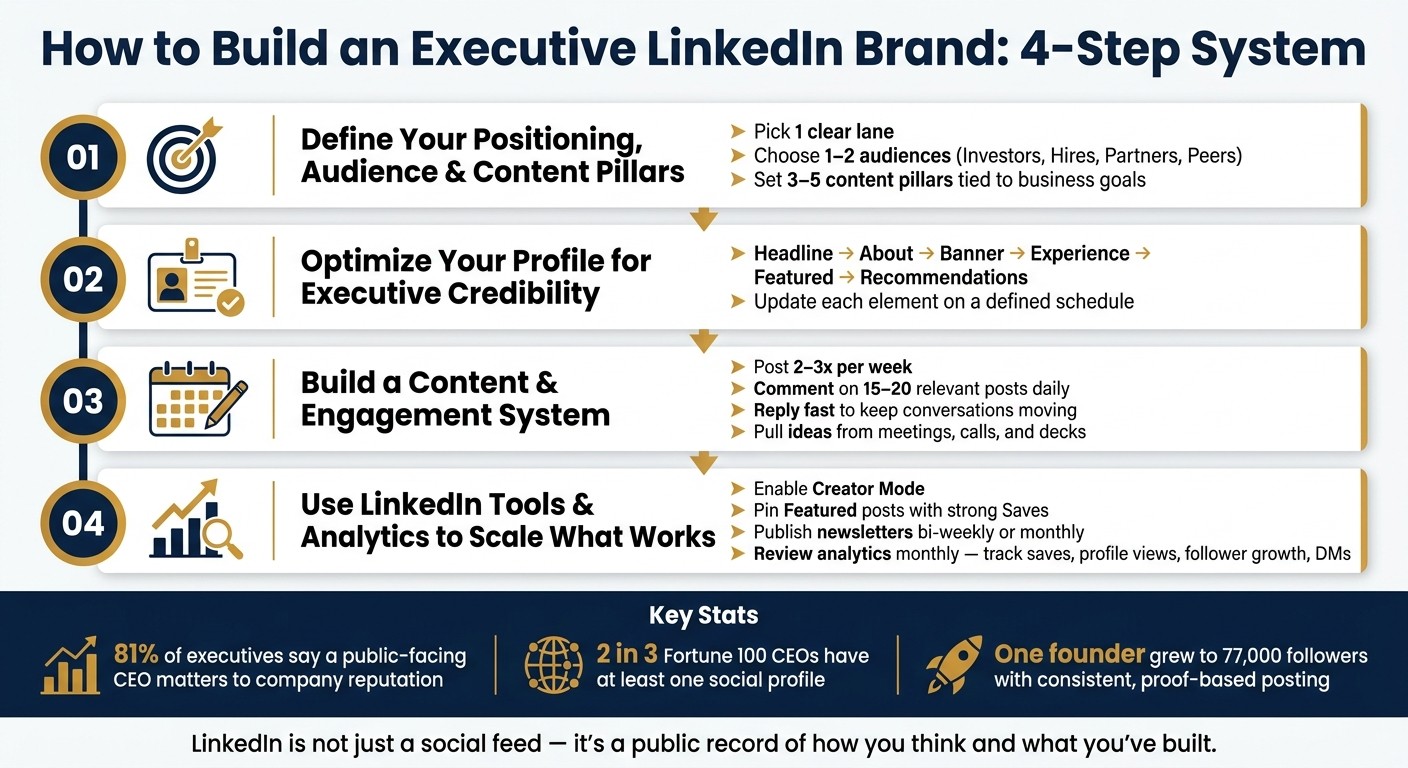
How to Build an Executive LinkedIn Brand: 4-Step System
Step 1: Define Your Positioning, Audience, and Content Pillars
Start by deciding what you want to be known for. Your positioning, audience, and content pillars give your LinkedIn presence a clear center of gravity.
Write a clear executive positioning statement
What should people connect with your name? Your positioning statement should answer that in one sentence. It tells people who you are, who you help, and the result you deliver.
A simple formula works well: [Role] + [Who you help] + [Outcome you drive].
Your headline, About section, and experience should all point to the same area of expertise and the same result. If those parts say different things, people get a blurred picture of who you are.
"The algorithm now rewards deep expertise over surface-level content. Pick your lane and own it." - Anthony Rahme
That idea matters. On LinkedIn, depth beats dabbling. Once you know your lane, the next step is deciding who most needs to hear from you.
Choose the audiences that matter most
If you try to speak to everyone, your message gets too broad to land. Pick one or two main audiences and let that choice shape your tone, examples, and topics.
Choose the audience that lines up with your current goal, such as hiring, fundraising, partnerships, or thought leadership.
Investors want market insight and signs that you think clearly about the business.
Prospective hires pay attention to culture stories and moments that show mission and values.
Customers and partners want proof that you understand their problems.
Industry peers often respond to contrarian takes and respected social proof.
Go past basic labels. Think about what your audience cares about, what frustrates them, and what doubts they may have before they ever talk to you. A founder speaking to early-stage investors will write in a very different way than a founder trying to recruit senior engineers.
Your audience choice should also shape the topics you come back to again and again.
Set 3 to 5 content pillars tied to business goals
Choose 3 to 5 content pillars based on the business result you need most right now. Each pillar should support both your expertise and your company’s current priority.
Here’s a simple way to map that out:
Content Pillar | Business Goal | Example |
|---|---|---|
Market Insight | Thought leadership, inbound leads | Industry breakdowns, solving audience objections |
Product Vision | Fundraising, partnerships | Specific metrics, dogfooding demos, feature reveals |
Leadership & Culture | Hiring, retention | Contrarian hiring decisions, internal philosophy |
Personal Journey | Authority, inspiration | Pivots, failures, lessons from building |
Company Milestones | Fundraising, credibility | Growth stats, investor updates, named social proof |
Harley Finkelstein uses frequent posts to share entrepreneurship stories and shape Shopify's narrative.
The key is to choose pillars that connect what you know with what the business needs now. If hiring is your top focus this quarter, spend more time on leadership and culture. If you’re raising a round, your feed should lean harder into market insight and company milestones.
Once your positioning and pillars are set, you can turn them into proof on your profile.
Step 2: Optimize Your Profile for Executive Credibility
Your LinkedIn profile should tell one clear story, fast: who you are, what you've built, and why it matters. The positioning and pillars from Step 1 should show up across every part of the profile so visitors get the same message wherever they look.
The table below shows which profile elements matter most for executive credibility and how often to review them.
Profile Element | Purpose and Executive Branding Impact | Update Frequency |
|---|---|---|
Photo | Creates an immediate sense of professionalism and puts a face to the brand | Every 1–2 years |
Banner | Reinforces the company's mission or a major initiative at a glance | Quarterly or per launch |
Headline | Helps with search and gives the right people a reason to click | Quarterly |
About | Explains the "why" behind your leadership path and helps turn visitors into warm leads | Twice a year |
Featured | Highlights media, decks, or top-performing content that signals authority | Monthly |
Experience | Shows proof that you can scale, hire, and drive revenue | Annually |
Recommendations | Builds trust through the words of board members, investors, and peers | Ongoing (request after wins) |
Upgrade Your Headline, About Section, and Banner
A headline that only says "CEO at [Company]" doesn't give people much to work with. Use that space to show the category you own or the outcome you help drive. LinkedIn looks at your headline, About, and Experience to understand your area of expertise, so those sections should all point in the same direction.
Your About section should feel like a leadership mission, not a resume recap. One simple structure works well: start with where you were 2–3 years ago, shift to where you are now, and hint at the path between those two points. That little arc gives people a reason to click "see more."
Your banner helps finish the first impression. Think of it like a billboard at the top of your profile. It should echo your company's direction or the category you're building in.
Once the story is sharp, you need proof behind it.
Turn Experience, Featured, and Recommendations into Proof
Generic Experience lines like "led growth initiatives" don't do much. Rewrite each role around measurable results. Use numbers tied to revenue growth, fundraising, hiring scale, or product launches. That's what makes executive credibility feel concrete instead of vague.
The Featured section is one of the best places to show your work. Pin a strong post, a media appearance, a pitch deck, or an interview. Then update it monthly so the section stays current.
Recommendations help in a different way. Ask board members, investors, or trusted peers for testimonials right after a visible win. Their words give you outside validation, and that goes a long way when someone is deciding whether to trust your profile.
After you've built trust, make the next move easy.
Add Contact Details and Next Steps for Profile Visitors
Don't make people guess what to do next. Add clear contact details, and use your About section to mention the types of conversations you're open to, like hiring, partnerships, or fundraising.
LinkedIn connection requests are limited to roughly 28 per day. That means a polished, complete profile can do some of the heavy lifting before outreach even starts.
Step 3: Build a Content and Engagement System That Fits Your Schedule
Most executives already have plenty of raw material for strong content. The missing piece is usually a system to spot it in the moment. A simple fix is to map each post to one of your content pillars, so your ideas don't feel random or disconnected.
Choose Post Formats That Match Your Strengths
The best executive posts usually come from actual business moments: customer objections, sales calls, podcasts, customer conversations, and shipping updates. Instead of sitting down later and trying to force ideas, pay attention while those moments are happening.
A few post types tend to work again and again:
Time-jump hooks that compare an earlier struggle with a current result
Contrarian leadership decisions that explain how you thought it through
Dogfooding or live-demo posts that show your product in use
Expert posts built around frameworks and checklists
Posts that use named social proof when it helps make the point
Once you know which formats fit you best, it gets much easier to build a schedule you can live with.
Set a Posting Cadence You Can Actually Keep
For most busy founders and executives, 2 to 3 posts per week is a pace they can keep up over time.
The easiest way to stay on that cadence is to collect ideas as you move through the week. Pull notes from board decks, customer calls, hiring decisions, internal memos, media interviews, and podcast transcripts. Repurposing what you already have is much faster than starting with a blank page. And using a steady publishing calendar works better than posting here and there with no rhythm.
It also helps to match your content mix to your current business goal. If you're hiring, lean more into leadership and culture posts. If you're raising, spend more time on market insight and company milestones.
Use Comments and Direct Outreach to Increase Reach
Publishing is only half the work. Thoughtful comments on 15 to 20 relevant posts each day, especially from customers, investors, and industry peers, can strengthen your topical fit and help more people notice you without needing another post.
Replies matter too. When people comment on your post, keep the conversation moving. And when someone engages in a meaningful way, that's often the right time to send a personalized connection request.
Stay focused on relevance. Write for the exact group you want to attract, whether that's candidates, investors, partners, or peers. Then use analytics to see which formats and posting rhythm get the best response.
Step 4: Use LinkedIn Tools and Analytics to Scale What Works
Once your posting rhythm is in place, use LinkedIn’s built-in tools to give extra reach to the content that’s already doing well. You do not need every feature. You just need the right setup, then a simple review process that helps strong ideas keep working over time.
Set Up Creator Mode, Featured Posts, and Newsletters
Creator Mode is a smart place to start. It makes Follow the main profile action, opens up newsletters and more analytics, and lets you add five “Talks about” topics. Those topics should match your main content pillars.
Use the Featured section to pin proof. That can include top posts, media, lead magnets, or a newsletter signup. Update it once a month. Give priority to posts with strong Saves, because saves are the strongest long-term signal in LinkedIn’s 2026 algorithm.
Newsletters work well for deeper ideas you can return to on a set schedule. Publishing every two weeks or once a month helps you build a recurring audience without adding too much pressure.
LinkedIn Tool | Main Use for Executives | Best Timing | Setup Notes |
|---|---|---|---|
Creator Mode / Profile Tools | Enables newsletters, analytics, and "Follow" as the default action. | Immediate / Day 1 | Make sure "Talks about" topics align with your core content pillars. |
Featured Section | Showcases proof, lead magnets, and high-performing posts. | Update Monthly | Pin posts with strong Saves or direct business impact. |
Newsletters | Builds a recurring audience for deeper thought leadership. | Bi-weekly or Monthly | Best for expert-level content like industry frameworks. |
Analytics Dashboard | Tracks profile views, audience demographics, and engagement trends. | Monthly Review | Focus on saves and direct messages that lead to meetings, not raw impressions. |
Review Analytics Monthly and Adjust Your Strategy
Raw impressions can look nice, but they don’t tell the whole story. What matters more is whether the right people are seeing your content.
Each month, review:
Profile views
Follower growth
Audience demographics
Look at whether your posts are reaching investors, candidates, partners, or buyers, not just a bigger crowd. If reach is high but follower growth stays low, especially with polls, that’s usually a sign to shift. Try more proof-of-work posts or personal stories that build trust with the people you want to reach.
Also watch which topics and formats drive the most Saves and the kind of direct messages that turn into meetings. If one post leads to inbound partnership talks, that theme is worth repeating. It’s a clue, plain and simple.
You should also update your headline keywords each month so they match the pillars you’re posting about. LinkedIn looks at your headline, About section, and Experience to check authority before it distributes your content.
Conclusion: Positioning, Proof, Consistency, and Iteration
These tools do one simple job: they make strong content easier to find, easier to trust, and easier to repeat.
Building an executive brand on LinkedIn comes down to four things you do again and again: know what you want to be known for, make your profile reflect that skill, post with consistency around a few strong themes, and use LinkedIn’s tools to sharpen what works.
You do not need to go viral. You need to stay visible to the right audience, show clear proof of what you know, and make decisions based on actual data.
FAQs
How long does it take to build an executive brand on LinkedIn?
Building an executive brand is a long game. It’s not a one-and-done project with a neat finish line.
Authority tends to build over years. But if you show up consistently, you can still see measurable growth in audience engagement and inbound interest within 90 days.
That short-term progress matters. On LinkedIn, steady and relevant interaction goes a long way. When you start speaking directly to your audience’s specific problems, business outcomes like hiring and pipeline generation can begin early in the process.
What should I post if I do not have much time to create content?
If you’re short on time, stick with consistent, lightweight posts. A simple way to do that is to share a quick “content moment” after a call, a customer objection, a hiring win, or a lesson learned. Use the same basic structure each time so posting feels easy, not like a whole new project.
If you work with a ghostwriter, give them raw material to work from. Notes, voice memos, rough bullets, and screenshots can go a long way. The aim is a credible, steady presence. Original thinking and consistency matter more than going viral.
How do I know if my LinkedIn brand is attracting the right audience?
Look past impression counts and focus on business outcomes. A strong LinkedIn brand should lead to inbound messages, meetings, and meaningful conversations with the people you most want to reach.
If followers aren’t turning into hiring, partnerships, or fundraising opportunities, your content may be getting broad reach but missing professional relevance. Review your content every quarter to spot which topics and formats bring in the right kind of response.