LinkedIn Personal Branding: A Guide for Founders
Social Media Marketing
Define your founder position, optimize your LinkedIn profile as a landing page, and post 2–3x/week with focused content pillars to drive hires, investors, and leads.

If you’re a founder, people will judge you before they judge your company. On LinkedIn, personal profiles can get 10x more engagement than company pages, and posts with a founder’s face can see up to 4x more views.
Here’s the short version: I need to do three things well if I want LinkedIn to help with hiring, investor interest, partnerships, and inbound leads:
Pick one clear position: one audience, one problem, one belief
Fix my profile: headline, About, and proof should show what I do and why it matters
Post on a steady schedule: 2 to 3 times per week around a few repeat topics tied to business goals
A strong founder presence can lower friction in sales and recruiting. 81% of executives say a visible CEO matters to company reputation. That means LinkedIn is not just a social channel. It’s a trust check.
The article breaks this down into a simple plan: define a sharp founder story, turn the profile into a landing page, choose a few post themes, and track whether the right people respond.
Define your founder narrative and market position
With your visibility goal set, the next step is to get clear on who you're speaking to and what belief your brand should stand for.
Choose the audience, problem, and belief you want to be known for
Pick one audience, one problem, and one point of view. If you try to speak to everyone, your brand gets watered down. Focus on the single audience that matters most to your business right now - whether that's investors, talent, or buyers - and build around that choice.
Then define that audience by what they value, what they believe, and what keeps them up at night.
After that, map their objections. Write down every pushback, doubt, or challenge they bring up about your product or service. Those objections become your content pillars. Your point of view is how you answer those objections, clearly and with conviction.
Once that position is set, you can turn it into a founder story you can use again and again.
Turn your operating experience into a repeatable founder story
Your narrative is not your biography. It's proof of your market position. The LinkedIn narratives that tend to work best use a simple structure: the starting point, the pivot, and the result.
Specificity is what makes a founder story land on LinkedIn. Skip vague claims. Use numbers, name the decision, and borrow the kind of language customers use. The posts that hit hardest usually aren't product announcements. They're moments that show judgment - like hiring for potential or slowing growth to fix the product.
That story should be visible right away in your LinkedIn profile.
Optimize your LinkedIn profile as a founder landing page
Turn your founder story into profile signals people can check in seconds.
Your LinkedIn profile is not a resume. It works more like a landing page with one job: help the right person grasp who you are, what you're building, and why it matters to them right away.
That means your headline, About, and Experience sections should match the expertise your posts talk about. If your content says one thing and your profile says another, people notice. And it doesn't just shape first impressions. It can also affect how far your content travels.
Write a headline and About section that explain your value clearly
A lot of founders default to “CEO & Co-Founder at [Company].” That shares your title, but it doesn't give people much of a reason to follow you.
A better headline spells out:
Who you help
What result you deliver
Your point of view
For example: "Helping B2B SaaS teams cut onboarding time in half | Founder @ [Company]".
Your About section should follow a simple three-part flow. Start with the market problem you're solving. Then move into your founder story - why you're the one working on this problem. Close with a direct reason to connect. Write in first person, and lead with the market problem instead of a career timeline.
Use Featured, Experience, and social proof to build trust fast
Use Featured for things like press coverage, demo videos, customer case studies, or milestone posts. The goal is simple: show the product, not just talk about it.
The same idea applies to Experience and recommendations. Rewrite Experience entries around business outcomes, not job duties. “Scaled revenue from $0 to $10M in 18 months” hits a lot harder than “Managed a cross-functional team.”
For recommendations, ask customers, investors, or operators to mention specific results. That kind of proof lands fast because it's concrete.
Once your profile lines up, your content can keep proving the same signals again and again.
Choose content pillars and post formats that build authority
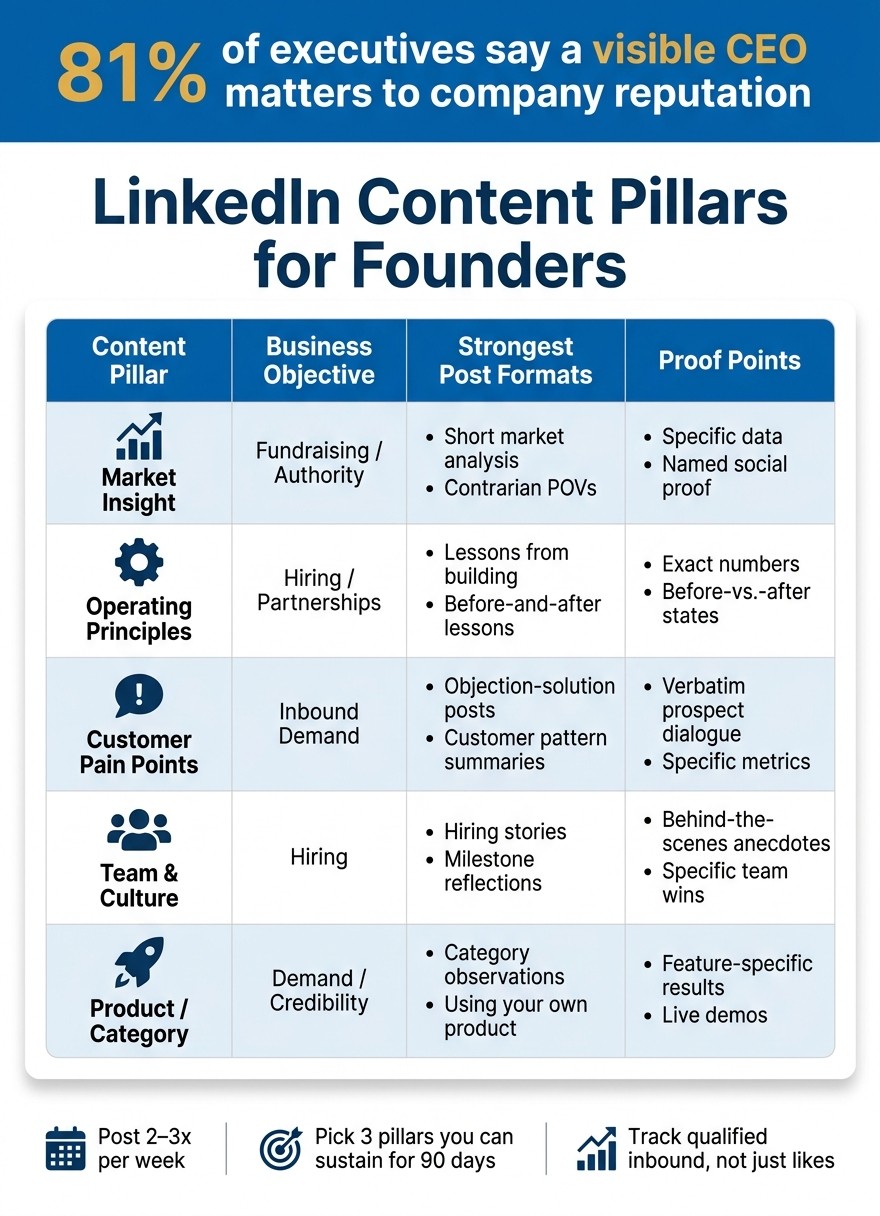
LinkedIn Content Pillars for Founders: Goals, Formats & Proof Points
Once your profile is clear, your content needs to back it up. This is where you turn your positioning into a repeatable system instead of posting whatever comes to mind.
A simple rule works well here: choose pillars that match both what your ideal customer believes and the objections you hear all the time. Start with the same audience, problem, and belief from your founder narrative. That keeps your posts tied to hiring, fundraising, and demand, instead of drifting into random commentary.
Pick 3 to 5 pillars linked to hiring, fundraising, and demand
Each pillar should connect to a business goal.
Market Insight helps build category authority and can support fundraising conversations. Operating Principles builds executive credibility and can help attract strong hires. Customer Pain Points can drive inbound demand because it speaks to the exact objections prospects bring up on sales calls. Team & Culture can help with recruiting by showing what it’s like to build at your company. Product / Category content can build demand and credibility through category observations, use of your own product, and live demos.
A useful filter: would a potential investor, hire, or customer care about this topic? If the answer is no, cut it. That kind of focus matters because LinkedIn is putting more weight on content that matches your profile expertise and is less forgiving of random topic swings.
Pillar | Business Objective | Strongest Post Formats | Proof Points |
|---|---|---|---|
Market Insight | Fundraising / Authority | Short market analysis, contrarian POVs | Specific data, named social proof |
Operating Principles | Hiring / Partnerships | Lessons from building, before-and-after lessons | Exact numbers, before-vs.-after states |
Customer Pain Points | Inbound Demand | Objection-solution posts, customer pattern summaries | Verbatim prospect dialogue, specific metrics |
Team & Culture | Hiring | Hiring stories, milestone reflections | Behind-the-scenes anecdotes, specific team wins |
Product / Category | Demand / Credibility | Category observations, using your own product | Feature-specific results, live demos |
In every post, use exact numbers, named examples, and real dialogue. That’s what shows how you think, what you’ve learned, and why your judgment is worth paying attention to.
For example, Wispr Flow CEO Tanay Kothari used his own product in the sign-off of his posts, turning them into both proof-of-work and a live demo. One post in that run generated over 1,900 reactions.
Pick the three pillars you can keep up for 90 days. Then build repeatable post formats around them so publishing feels less like improvisation and more like a system.
Set a realistic publishing cadence for busy executives
For most founders, two to three original posts each week, plus thoughtful comments on relevant posts, is a pace they can keep up. Consistency beats volume. Treat posting like a release schedule: predictable, deliberate, and tied to a goal.
Build a simple system to publish consistently and measure results
Once your pillars are set, you need a simple system to catch ideas and publish on a steady schedule.
Pull content ideas from meetings, customers, and company milestones
Use meetings, customer objections, and company milestones to reinforce the market belief you want to own. Sales calls, hiring interviews, and product launches are packed with post ideas. The goal is simple: catch the idea in the moment instead of trying to come up with one later.
Right after each meeting, drop the idea into a notes app or voice memo. Don’t polish it. Just save the raw thought. You can also track repeat objections and draft 3 to 5 responses for each one. One session can turn into 30+ post ideas.
"Content isn't created. It's noticed. Big difference." - Ajitika Singh
Those captured notes then become next week’s draft queue.
Use a basic weekly planning and analytics loop
A weekly system helps you stay consistent without adding extra mental strain. For busy founders, 2 to 3 posts per week is often enough, especially if you batch drafts in one weekly content block.
Check LinkedIn analytics each week and focus on signals that matter: qualified inbound, hiring interest, and partner outreach from the audience you want to reach. If those signals are weak, lean harder into specific customer objections instead of broad topics. Then use what you learn to shape next week’s posts.
When to bring in outside support for your LinkedIn presence
Bring in outside help when the ideas are there, but drafting and posting keep slipping. Good support takes your notes, objections, and milestones and turns them into a repeatable publishing system. It’s not a new strategy. It’s steady execution of the one you already have.
"Perfection is the enemy of progress. Force yourself to write + post in that block." - Matt Huang, Founder, Forj Media
Conclusion: Your LinkedIn branding roadmap as a founder
Build your brand in three steps: define your position, tune your profile, and publish on a steady schedule.
Start with one audience and one belief you want to own. Then treat your profile like a landing page. Your headline and About section should make it obvious who you help and the outcome you deliver. After that, pick a few content pillars based on your experience, what you’ve learned, and what you can teach through story.
Watch for signals that tie back to the business: profile views from ideal clients, connection requests from decision-makers, and interest from strong candidates. If those signals are weak, the issue is often sharper positioning and steadier content, not posting more just to post.
Clear positioning, a profile that builds trust, focused content pillars, and a simple weekly loop to publish and review can build momentum. Founders who stay consistent and keep their content tied to what they know best tend to earn more trust, stronger inbound, and better opportunities.
FAQs
How do I choose the right LinkedIn audience?
Focus on your Ideal Customer Profile (ICP), not just basic details like age or location. Get clear on what your audience cares about: their values, attitudes, and beliefs.
A simple way to tighten that focus is to listen to the objections you hear every day. Those pushbacks tell you what people are worried about, what they don’t buy into yet, and what they need help sorting out.
The best LinkedIn content speaks to a specific group and solves problems they actually face. That’s what leads to more relevant conversations and better opportunities.
What should I post if I have little time?
If time is tight, put consistency ahead of complexity. If your energy is better spent on fundraising or hiring, a ghostwriter can help you keep a solid presence without having to do everything yourself.
If you’re handling it on your own, block off 30 minutes each morning or set aside one content day each week. You can also save time by jotting down content ideas in a notes app and reusing interviews, podcasts, or other content you already have.
How do I know if my LinkedIn brand is working?
Track metrics that connect to actual business results, not just feel-good stats. Pay attention to impressions, follower growth, and especially inbound DMs from people who are clearly interested.
The clearest signs things are working are more visibility, more trust, and more chances tied to hiring, fundraising, and partnerships. Review your content on a regular basis so you can cut topics that fall flat and do more of the formats that bring in your best engagement.