LinkedIn Profile Checklist for Founders and CEOs
Social Media Marketing
Checklist to optimize founders' and CEOs' LinkedIn profiles: clear headline, proof-based About, updated Featured, and outcome-driven Experience.

Your LinkedIn profile should help you get hires, meetings, investor interest, and partner replies - or it’s costing you.
If I were checking my profile today, I’d focus on four fixes first: a clear headline, a proof-based About section, current Featured items, and Experience entries with numbers. That matters because many people will judge me before a call, and 81% of executives say a visible CEO matters to company reputation.
Here’s the short version of what to check:
Profile basics: photo, banner, custom URL, location, and working contact links
Positioning: headline, About section, and search terms tied to my space
Proof: Featured section, Experience entries, recommendations, and public activity
Business goal: make the profile match what I want now - hiring, funding, partnerships, or thought leadership
A strong profile does a few simple things:
Shows who I am and what my company does in seconds
Makes it easy for people to find me in LinkedIn search
Gives proof, not vague claims
Builds trust before a meeting
Turns profile views into replies, applications, and intros
Use this checklist as a short audit. I’d start at the top of the profile, fix what people see first, then tighten the message and add proof.
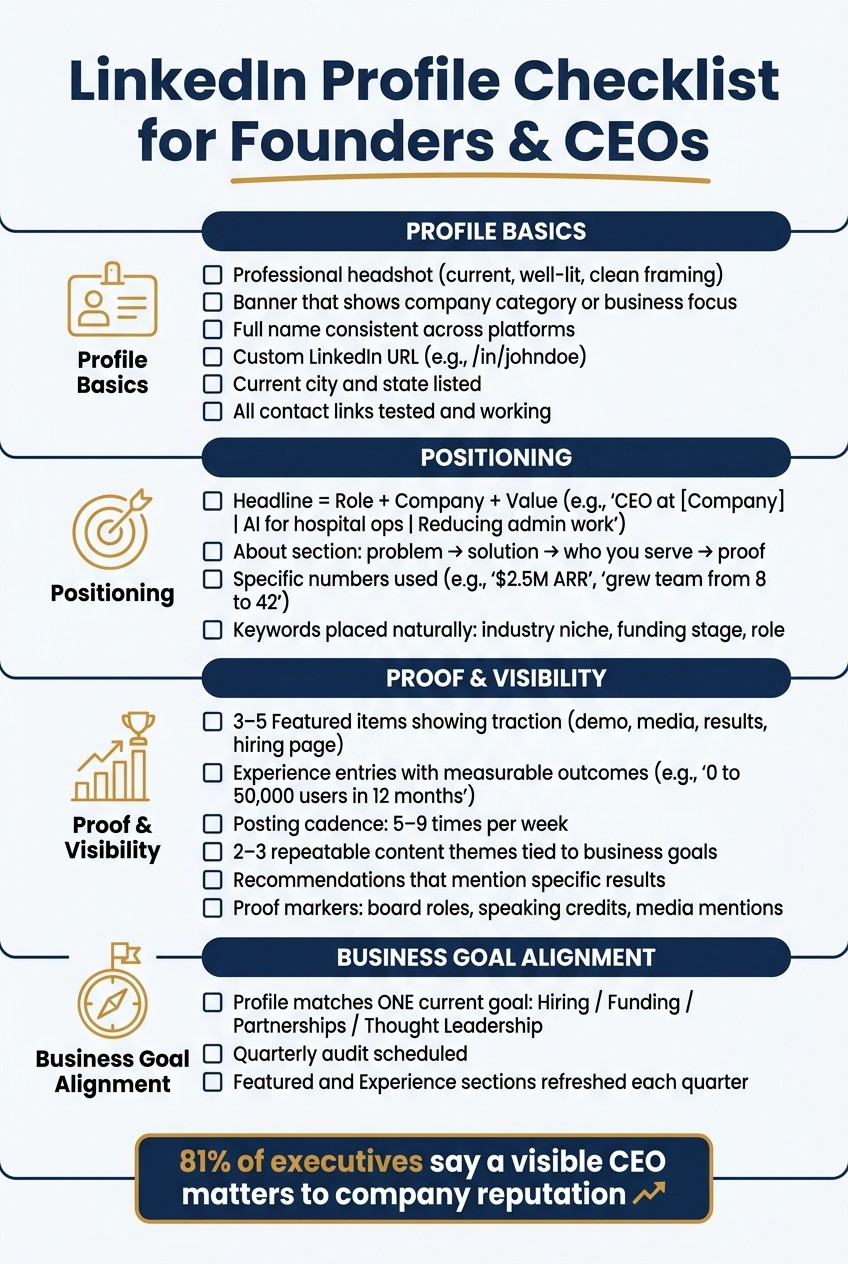
LinkedIn Profile Checklist for Founders & CEOs
Profile basics checklist: photo, banner, name, URL, and contact info
Your header shapes first impressions fast. Before anyone reads a single line, they’ve already made a snap judgment based on your photo, banner, name, and whether your contact details seem up to date.
That first scan affects trust. It can decide whether someone clicks, connects, or reaches out. So start with the visible basics first. Then move to your messaging.
Photo and banner that look credible at a glance
A current headshot and a purposeful banner help people trust you right away. On the flip side, a blurry photo, a cropped group shot, or no photo at all sends the wrong signal.
Your banner is the second thing people notice. And generic stock images - city skylines, keyboards, abstract gradients - don’t say much about you or your company. Use that space to show your company category or business focus.
Clean design wins. Clutter loses.
Also, check how your photo and banner look on mobile. That matters because many stakeholders will first see your profile on a phone. Once the visual layer looks right, move to the profile fields that affect search and sharing.
Name line, custom URL, location, and contact details
Use your full name and keep it the same across platforms. Set a custom LinkedIn URL too. The default string is harder to share and looks rough in email signatures and investor materials.
Add your current city and state. That can affect how you show up in local and industry searches.
Then open your Contact Info section and test every link. Check your website, email, and any other paths listed there. Broken links make the profile look ignored.
Common profile mistakes vs. stronger setup
Profile Element | Common Mistake | Stronger Setup |
|---|---|---|
Photo | No photo, low-res, or a cropped group photo | Current headshot with clean framing and good lighting |
Banner | Generic stock visuals or cluttered graphics | Shows company category or business focus |
Custom URL | Default string (e.g., | Clean, professional URL (e.g., |
Contact Info | Outdated email or broken website links | Current email, active website, and links to investor or hiring materials |
Next: tighten positioning with your headline, About section, and keywords.
Positioning checklist: headline, About section, and keywords
Once your profile looks credible, make it easy for the right people to get what you do in a few seconds. This is where a lot of founder profiles miss the mark. The issue usually isn't a lack of credibility. It's that the profile doesn't spell it out clearly.
Headline that states your role, company, and what the company does and why it matters
Use your headline to show your role, company, and value in one line. A title by itself - "CEO" or "Founder & CEO" - doesn't tell a recruiter, investor, or potential partner why they should care. A stronger version pulls those pieces together: "CEO at [Company] | AI software for hospital operations | Reducing admin work for care teams."
You can also add a proof point if it sharpens the message, like funding, revenue, or market reach. Tanay Kothari, CEO of Wispr Flow, called out the company's $81 million raise from investors including Menlo Ventures and NEA in his headline, which gave readers instant proof.
After the headline, the About section should build on that promise and back it up.
About section that tells your founder story with proof
Use the About section to explain the problem, your solution, who you serve, and the proof behind it. Keep paragraphs short. Write in plain English. Skip vague claims and use specifics instead - "$2,500,000 ARR", "grew the team from 8 to 42," or "reduced admin load by 45 minutes per shift." Details like these make the story easier to trust.
A simple before-and-after structure works well: where the company started, where it is now, and what changed. That gives people a reason to keep reading past the first couple of lines.
Then work in keywords naturally so your profile shows up in the right searches.
Keywords aligned with hiring, fundraising, and partnerships
Use keywords to help LinkedIn connect your profile with the right searches and make your niche clear. Terms like "Enterprise SaaS", "Health Tech", "Fintech Infrastructure", "Series A," or "go-to-market strategy" can fit naturally into your headline, About section, and experience entries. The key is to use them in context, not dump them into a block.
If your company works in Voice AI, say what the product does, who uses it, and what stage the company is in. That covers the keyword while still sounding like a person wrote it.
Keyword Type | Examples | Where to Place It |
|---|---|---|
Role & authority | Technical Founder, GTM Leader, CEO | Headline, About opening line |
Funding & growth | Series A, $81M raised | Headline, About section |
Industry niche | Voice AI, B2B SaaS, health tech, fintech | Headline, About, experience entries |
Business stage | Go-to-market, scaling | About section, experience descriptions |
Once your message is clear, support it with visible proof in Featured, Experience, and social signals.
Trust and visibility checklist: Featured section, experience, creator signals, and social proof
Turn your positioning into proof. People should spot credibility within seconds.
Featured section and experience entries that show traction
Start with the parts people see first.
Use 3 to 5 Featured items that show traction: a product demo, customer result, media mention, hiring page, or podcast appearance. Posts made with your own product work especially well because they double as proof and a live demo.
Your Experience section should back up the claims in your headline and About section. Skip the long lists of duties. Instead, add a one-line company description and follow it with measurable outcomes. For example, "Grew from 0 to 50,000 users in 12 months" says far more than "led growth initiatives".
Creator mode signals and recent activity that support thought leadership
Next, show that your profile is active, not frozen in time.
Post on a steady cadence. Publishing 5 to 9 times per week can help keep your profile visible, and repurposing podcasts, interviews, and top-performing posts is a simple way to keep that pace going.
It also helps to stick to 2 to 3 repeatable content themes tied to your business goals. That could mean hiring, fundraising, product traction, or your view of the market. This makes your profile feel focused instead of all over the place.
Recommendations, endorsements, and proof markers that build trust
Recommendations matter more when they mention results. Ask investors, customers, senior team members, or respected peers to add context instead of generic praise.
You can also strengthen your profile with proof markers tied to your current role, such as:
Board positions
Speaking credits
Media mentions
Milestone posts
These signals can support hiring, fundraising, and partnerships. Keep them easy to scan.
Conclusion: Run a short quarterly LinkedIn profile audit
Your LinkedIn profile should change as your business changes. A quick check every quarter helps keep it lined up with what you want NOW, not what mattered six months ago.
Tie each review to one main goal: hiring, fundraising, partnerships, or thought leadership. That keeps the process simple and stops you from making random edits that don't move anything forward.
The 4 fixes to prioritize first
If you only have an hour, start here:
Rewrite your headline so it clearly states your role, company, and value.
Tighten your About section with a clear story and proof.
Refresh your Featured items to show current traction.
Strengthen your Experience entries with outcomes and numbers.
Small quarterly edits keep your profile current, credible, and useful.
FAQs
How often should I update my LinkedIn profile?
Your LinkedIn profile is an active asset for credibility, hiring, and fundraising. It’s not a static document sitting on a shelf. It should track with your current business goals and the way you want people to see you.
There isn’t a fixed update schedule. But your profile should stay in sync with your current story, not the one you were telling six months ago.
At the very least, review it when your professional narrative changes. That usually means moments like:
after a product launch
after a fundraising round
after a major shift in company strategy
Those are the points when people are most likely to look you up. If your profile feels out of date in that moment, it can send the wrong signal fast.
What should I feature if I don’t have major press or funding yet?
Focus on proof of work if you want people to trust you.
That means showing clear, high-value evidence. Share specific stories about contrarian calls you made. Talk about what happened next, with exact numbers and plain results. Bring people into your in the arena lessons too - the wins, the misses, and what each one taught you.
You can also borrow authority in a smart way. Talk about debates you've had with respected peers. That signals you know the space and can hold your own. Another strong move: dogfood your own product in public posts. When people see you using what you sell, your point lands harder.
It also helps to treat your profile like a product. Don’t leave it to chance. Use structured templates to share ideas, lessons, and data in a way people can scan and remember.
How can I tailor my profile for hiring versus fundraising?
Align your profile with what your audience wants.
If you're hiring, lead with your vision, your team culture, and the reason your company exists. That’s what helps attract strong candidates. People looking at jobs aren’t just scanning titles. They want to know what they’d be joining and why it matters.
If you're fundraising, take a different angle. Show institutional authority through contrarian business insights, specific milestones, and hard metrics people can point to. Investors want proof. They’re looking for growth signals, market position, and signs that you know where the business is headed.
In both cases, your headline, About section, and Featured content should all point to the same goal. For candidates, that means inspiration and clarity. For investors, it means evidence of growth and market leadership.