Ghostwriting vs. DIY Content: What Works for CEOs
Social Media Marketing
Compare DIY, ghostwriting, and hybrid content for CEOs—time, voice control, cost, and business outcomes to pick the right model.

If you're a CEO, the best content model is usually the one you can keep doing when your calendar gets messy. In most cases, that means: DIY gives you full voice but eats time, ghostwriting saves time but can drift off-tone, and hybrid sits in the middle.
Here’s the short version:
DIY fits if you like to write and can spend 3–10+ hours per week
Ghostwriting fits if time is tight and you can spare 15–60 minutes per week
Hybrid fits if you want your ideas to stay yours, but want help turning them into posts
CEOs often use LinkedIn for hiring, fundraising, pipeline, and thought leadership
One example in the article shows 700,000+ monthly impressions and five figures in revenue within 90 days from a hybrid setup
81% of executives say a visible CEO matters for company reputation
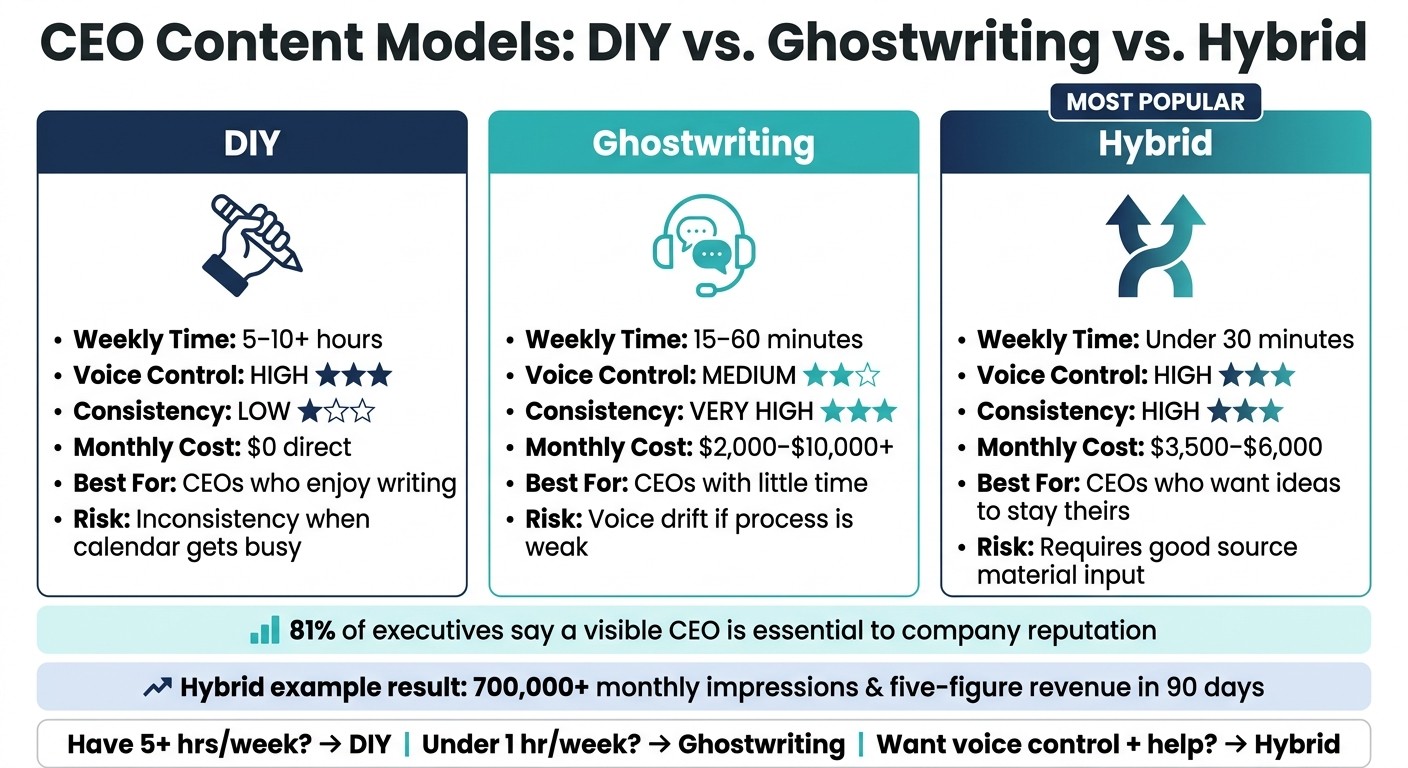
CEO Content Models Compared: DIY vs. Ghostwriting vs. Hybrid
Quick Comparison
Factor | DIY | Ghostwriting | Hybrid |
|---|---|---|---|
Time per week | 5–10+ hours | 15–60 minutes | Under 30 minutes |
Voice control | High | Medium | High |
Posting consistency | Low | Very high | High |
Speed to publish | Slow | Fast | Medium to fast |
Monthly cost | $0 direct cost | $2,000–$10,000+ | $3,500–$6,000 |
Best for | CEOs who like writing | CEOs with little time | CEOs who want help without losing their point of view |
I see the article’s main takeaway like this: if you stop posting when travel, hiring, or fundraising gets busy, DIY will be hard to keep up. If you want steady output with little time spent, ghostwriting or hybrid is often the better call. The main thing to watch is whether the posts still sound like you.
Ghostwriting for CEOs: High Consistency, Low Time Commitment
LinkedIn ghostwriting means a writer takes your ideas and turns them into posts that go out under your name. You stay active on the platform without having to write every post yourself. The thinking is still yours. The writer handles the draft. For CEOs, that tradeoff makes a lot of sense when time is tight and showing up week after week matters.
The process usually includes regular voice interviews, pulling from existing assets, drafting, review, publishing, and performance tracking. Your job isn't to stare at a blank page. It's to give direction, react to drafts, and sharpen the message. Once the rhythm is in place, many CEOs spend about 15 to 60 minutes per week on the process, mostly on idea capture and review. In the U.S., pricing often falls between $2,000 and pricing often falls between $2,000 and $10,000+ per month, based on posting volume and the level of support0,000+ per month, based on posting volume and how to choose a LinkedIn ghostwriting agency that provides the right level of support. That makes ghostwriting a strong fit when your main goal is consistency.
Where Ghostwriting Works Best
Ghostwriting works best when steady posting matters more than sitting down to write every day. A ghostwriter can handle the structure, the opening hook, scheduling, and the day-to-day cadence, even when your calendar is packed.
Over time, that kind of steady presence helps people get familiar with your point of view. One example shows a B2B founder posting targeted content five times per week, spending less than 30 minutes per week on feedback, and generating more than 700,000 monthly impressions. That's hard to match with random DIY posting. The weak spot shows up when the posts are polished on the surface but stop sounding like the CEO behind them.
Where Ghostwriting Falls Short
The biggest risk is voice drift. The posts may read cleanly, but they don't sound like you. Instead, they start to feel generic, overly careful, and flat.
Ghostwriting only works if the ideas actually come from the CEO. If the writer is guessing what you think instead of pulling it out of you, the content gets hollow fast. The fix is a tighter process:
regular voice capture sessions
clear editorial guardrails
an active review step where you mark anything that feels off
The aim is simple: sound like the CEO, not like a polished stand-in.
DIY CEO Content: Stronger Raw Voice, Higher Time and Discipline Requirements
If ghostwriting gives you consistency, DIY gives you the CEO’s raw voice. In this setup, the CEO writes, edits, and publishes every post on their own. That means they handle the ideas, research, drafting, visuals, scheduling, and ongoing optimization. That’s the price of keeping the voice fully in-house.
Where Founder-Written Posts Perform Well
DIY tends to work best when the CEO wants to share a direct point of view people can trust. It works well when they can explain one idea clearly, post on a steady cadence, and keep bringing fresh insights to the table. These posts often hit hardest when they say what other people dodge, because that kind of honesty builds credibility and trust. In most cases, DIY content builds credibility and thought leadership first, then helps with lead generation later.
Why DIY Often Breaks Down
The biggest problem is inconsistency. Ideas stack up, posts come out in bursts, and then the gaps stretch from days into weeks. Without a routine, even strong ideas never make it to the feed.
DIY posts can also fall short on hooks and clean formatting. So even when the main idea is good, it’s harder to keep momentum going. Good ideas only build visibility when they actually get published on a steady basis.
That tradeoff stands out even more when you compare DIY with ghostwriting and hybrid setups.
Ghostwriting vs. DIY vs. Hybrid: Direct Tradeoffs for CEOs
The clearest way to see the tradeoff is to put the three models next to each other. At the end of the day, the best option isn't the one that looks good on paper. It's the one you can keep doing long enough to see results.
Time, Voice, Quality, and Consistency: How the Three Models Compare
The table below shows how DIY, ghostwriting, and hybrid compare across the factors that tend to matter most to CEOs.
Factor | DIY | Ghostwriting | Hybrid |
|---|---|---|---|
Weekly Time | 5–10+ hours | Low (15–60 minutes) | <30 minutes |
Voice Drift Risk | Low (raw voice) | Medium (needs good voice capture) | Low (CEO-led ideas) |
Content Quality | Variable | High | High |
Consistency | Low (often breaks down) | Very high | High |
Time from Idea to Post | Slow | Fast | Moderate/Fast |
Monthly Cost | $0 (high opportunity cost) | Highest | $3,500–$6,000 |
DIY tends to lose on consistency more than anything else. Matt Huang, Founder of Forj Media, says it bluntly:
"Anyone who says 'let's just have our CEO post a couple times / week on LinkedIn' has never actually tried to do it for more than a few weeks. Nothing is ever as simple as it seems."
That lines up with what happens in practice. DIY usually slips first when the CEO is traveling, hiring, or fundraising. Ghostwriting and hybrid setups are built for the weeks when the calendar goes off the rails, so posting can keep moving even when time gets tight.
Time and voice matter. But for most CEOs, the bigger question is simple: what does each model do for the business?
Business Outcomes: Hiring, Fundraising, Pipeline, and Thought Leadership
Your content model shapes hiring, fundraising, pipeline, and thought leadership.
That matters because 81% of executives believe a visible CEO is essential to a company's reputation. On top of that, more than two-thirds of Fortune 100 CEOs now keep at least one social media profile. So this isn't just a branding side project. It's now part of how leaders are seen.
The business case shows up most clearly in three places:
Hiring: Visible leaders tend to pull in top engineers and operators who want to work for someone they can actually see and hear from.
Fundraising: A steady public presence gives investors a direct read on how a CEO thinks and communicates, without depending on media coverage.
Pipeline: In B2B, content ROI often starts compounding in months 4 through 6, when warm leads who've been watching quietly from the sidelines begin to convert.
Here's a concrete example. In early 2026, a Forj Media client - an 8-figure entrepreneur - reached more than 700,000 monthly impressions and generated multiple five figures in revenue within 90 days. The setup used a hybrid model: bi-weekly syncs, less than 30 minutes of CEO feedback each week, and five posts shipped per week by the agency.
That's the draw of a hybrid system. You can get scale without giving up the CEO's point of view.
Use this comparison to pick the model that matches your schedule, your voice, and your growth goals. Next, turn that comparison into a simple decision framework.
Conclusion: A Simple Decision Framework for Busy CEOs
Pick the model you can stick with when your calendar gets packed. Use your time, how much control you want over your voice, and your ability to publish on a steady cadence to make the call.
Choose DIY if you like writing, can set aside 3+ hours per week, and can post 3–5 times per week on a steady basis. Choose ghostwriting if time is the main constraint and you'd rather spend less than 30 minutes a week giving feedback. Choose hybrid if you want to keep control of your ideas and voice but need help turning source material - like voice notes, interviews, or podcast transcripts - into posts, while the team handles the hook, structure, and scheduling.
Start early. Visibility builds over time.
If none of those three options matches your bandwidth, it may be time to stop treating content like a habit and start treating it like a system.
When a Structured Executive Content System Makes Sense
Some CEOs don't just need a writer. They need a system. That includes positioning, story development, content creation, profile management, and results tracking working together.
If you want your LinkedIn presence to help with hiring, fundraising, or pipeline growth without taking much time out of your week, a structured executive content system is worth a look. The best setups reuse transcripts, podcast clips, and internal memos.
FAQs
How do I know if hybrid is right for me?
A hybrid model makes sense if you want to keep your own voice but keep running into scheduling bottlenecks that lead to inconsistent publishing.
It tends to work best when you can supply the raw material - like personal anecdotes, industry insights, or voice notes - but don’t have the time to run the whole content process yourself. That way, your expertise stays the source of truth, while a partner handles the research, drafting, and scheduling.
How long should I test one content model?
Stick with one content model for at least 3 to 6 months if you want results that mean anything for the business. Things like building authority or closing long-cycle B2B deals usually won’t show up in month one.
Content tends to compound over time. That’s why consistency matters so much when you’re trying to measure what’s working. A 3- to 6-month test window also gives you enough time to adjust your strategy based on performance data instead of making calls too early.
What should I look for in a ghostwriting process?
Look for three things: a strong voice-capture method, a clear workflow, and proof they can match a founder’s voice.
That means:
Recurring interviews that pull out your real stories, opinions, and perspective
A steady content calendar with review loops and stakeholder alignment
Specific examples of past work
Skip vague processes. And be careful with partners who treat your input like an afterthought.