5 Signs Your LinkedIn Strategy Is Not Working
Social Media Marketing
Five warning signs to spot when LinkedIn gets likes but not meetings, hires, or investors—check audience, profile, content, hooks, and metrics.

If LinkedIn is not leading to DMs, calls, hires, or investor interest after months of posting, the problem is usually your plan, not your effort. In most B2B cases, it takes 4–6 months to turn steady posting into business results, so I look for patterns, not one bad week.
Here’s the short version:
You’re getting engagement from the wrong people
Your profile gets views, but no one takes the next step
Your posts send mixed signals
Your content gets seen, but it doesn’t connect with decision-makers
Your activity does nothing for pipeline, hiring, fundraising, or authority
I’d judge LinkedIn with business signals first:
ICP profile views
Qualified inbound DMs
Booked calls
Candidate quality
Pipeline tied to LinkedIn
Likes and impressions can look good. But if they don’t lead to meetings or money, they don’t mean much.
Quick comparison
Sign | What it usually means | First thing I’d check |
|---|---|---|
Wrong-audience engagement | Your content is pulling in noise, not buyers | Who is commenting and messaging you |
Profile views with no inbound | Your profile message is unclear | Headline, About section, CTA |
Mixed positioning | You’re posting about too many things | Your last 10 posts |
Weak reach or weak fit | Your hooks or format are off | First lines, saves, reposts |
Busy activity, no business result | Your posts are not tied to one goal | DMs, meetings, pipeline |
If I saw one of these signs, I wouldn’t post more. I’d fix the gap between visibility and business outcome.
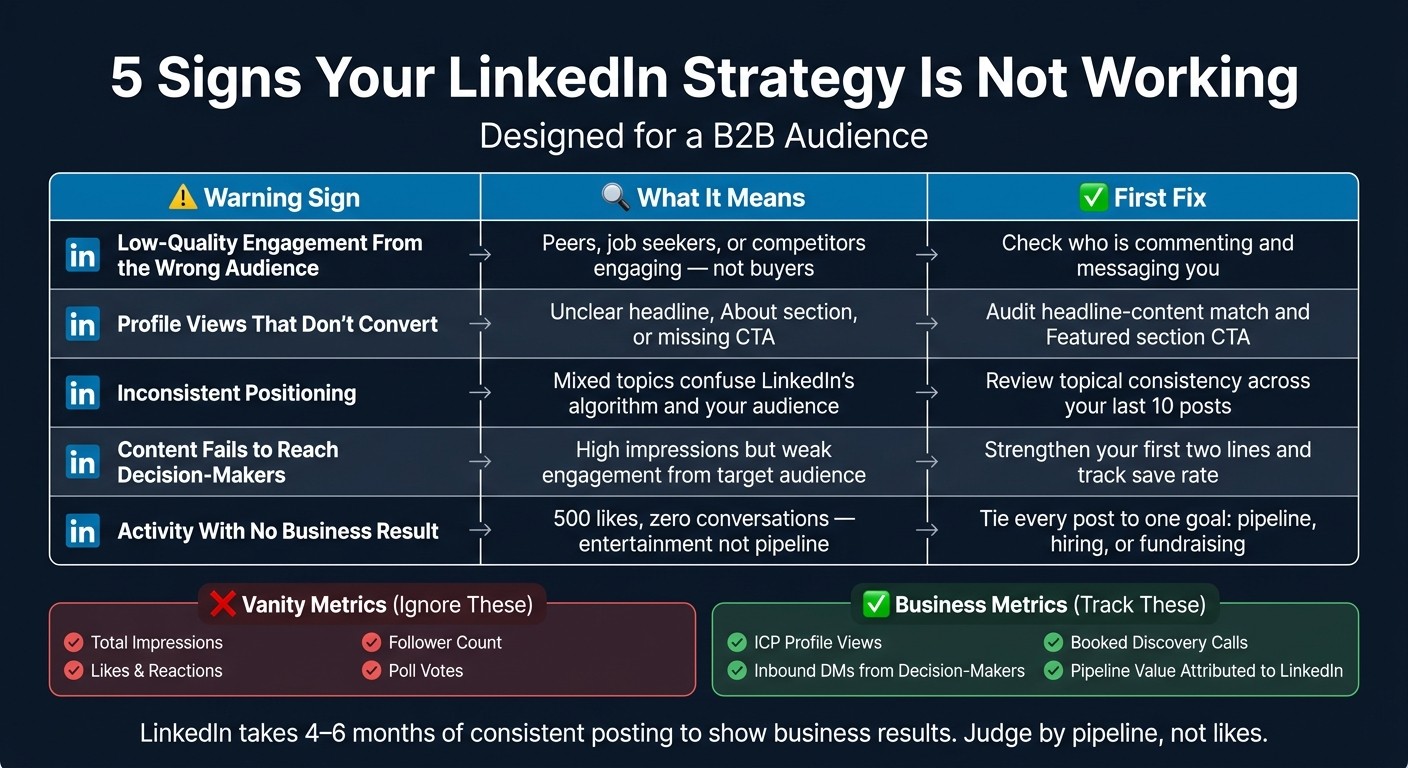
5 LinkedIn Warning Signs: Vanity Metrics vs. Business Metrics
Why Your LinkedIn Strategy Isn’t Working with Neal Schaffer | Counsel-Cast.com
How To Read These Warning Signs
Before you diagnose any of the five signs below, separate the metrics that look good from the ones that move the business. That’s the first step: know which signals matter.
Likes, follower growth, and high-volume impressions are vanity metrics. They don’t tell you much about whether LinkedIn is driving pipeline, hiring interest, or investor attention. What matters is whether LinkedIn is helping you build pipeline, attract strong candidates, earn investor attention, or build authority.
LinkedIn’s algorithm treats saves and reposts as strong engagement signals, indicating high-value content people want to reference later. So don’t get distracted by reach alone. Track business value.
Focus on signals like:
Profile views from your ideal customer profile (ICP)
Qualified inbound messages
Booked calls
Candidate quality
Attributed pipeline
And don’t judge this from one post. Look at trends over several weeks.
If profile views from decision-makers have stayed flat for weeks, inbound messages aren’t coming from people you’d want to talk to, or your content is getting reach without leading to business conversations, that’s not a one-off. That’s a pattern.
Start with audience fit: the first warning sign shows whether your engagement is coming from the right people.
1. Low-Quality Engagement From the Wrong Audience
Likes and comments can feel like momentum. But that feeling fades fast when none of it turns into DMs, meetings, or inbound leads. That’s the heart of low-quality engagement: it looks like progress, but it doesn’t lead to pipeline, hiring, or investor interest.
The clearest red flag is simple. Your posts are getting attention from people outside your ICP. If most of the engagement comes from peers dropping “Great post!” comments, job seekers, or competitors looking around, your content is acting more like social chatter than a business signal.
A lot of engagement without qualified conversations is just noise.
It can also make the problem worse. Wrong-audience engagement teaches LinkedIn to show your posts to more of the same people instead of the decision-makers you want to reach.
LinkedIn rewards content people save and repost because it signals practical value.
Engagement Signal | What It Tells You |
|---|---|
Generic "Great post!" comments | Wrong audience |
20+ word replies from niche professionals | Right audience |
Saves and reposts from 2nd/3rd-degree connections | Reach beyond your peer circle |
Profile views from job seekers or competitors | Positioning mismatch |
Inbound DMs from decision-makers | Strategy working |
If engagement is high but qualified conversations stay flat, the problem isn’t reach. It’s audience fit.
And if the right people are seeing your content but nothing moves forward, the next issue is conversion.
2. Profile Views That Don't Convert Into Inbound Opportunities
Profile views don't matter much if they never turn into DMs, calls, or replies. When that gap shows up, the issue usually isn't reach. It's unclear positioning.
If your headline, About section, and posts aren't saying the same thing, interested visitors won't know what to do next. A headline like I help founders grow is too vague. It doesn't give a decision-maker a reason to stick around. But a headline aimed at Series A SaaS founders dealing with product-market fit tells the right person, right away, that they're in the right place.
That's the whole game: specific and consistent messaging. When your profile is clear, the right visitors take action. When it's fuzzy, they bounce. So if the right people are landing on your profile but not doing anything, don't blame reach. Look at profile clarity.
Your profile should make the next step easy to spot. Proof of work, clear results, and steady positioning matter more than a big follower count. Add a direct call to action to both your profile and your posts, so investor replies, hiring inquiries, and qualified sales conversations have somewhere to go.
If views are going up but inbound stays flat, check whether your headline, About section, and posts line up. You can also DM people who engaged or follow up with warm viewers to turn attention you already have into actual conversations.
Metric to Audit | What It Signals | Fix |
|---|---|---|
ICP profile views | Audience relevance | Tighten headline, About, and featured proof to attract ICP visitors |
"See More" clicks | Hook effectiveness | Open with a specific pain point your ICP recognizes |
Saves | Content utility and authority | Create frameworks, checklists, or practical guides |
Inbound DMs | Conversion and trust | Add a clear CTA to your profile or post |
If your profile is clear but interest still goes nowhere, the next issue is inconsistent positioning.
3. Inconsistent Positioning and Scattered Thought Leadership
If your profile says one thing but your posts say another, your LinkedIn positioning is off. For example, a founder who talks about SaaS growth one week and AI regulation the next creates mixed signals. That makes it tougher for LinkedIn to match your content with the right audience. It also makes it tougher for people to know what you’re known for.
This is the scattered thought leadership trap. When your themes are all over the place, your signal gets weaker over time. Posting more won’t fix that. A steady point of view builds authority faster than a higher posting cadence, especially when supported by better LinkedIn content for your executive team.
The fix is pretty narrow. Audit your content and ask a simple question: do these themes point back to one core area of expertise? If not, tighten things up. Stick to two or three content pillars, and put more weight on frameworks and industry breakdowns. Those formats tend to travel farther beyond your immediate network.
If your topics are consistent and engagement is still weak, the issue may not be positioning at all. At that point, the problem is more likely reach or resonance. In plain English, your message may be clear, but it still isn’t landing with the right people. That’s where the next sign comes in: weak content resonance.
4. Content That Fails To Reach or Engage the Right People
If your positioning is clear but results still lag, look at distribution next. Your message may make sense. But if it’s not getting in front of the right people, it won’t do much.
A common red flag is high impressions paired with weak engagement from decision-makers. That usually means your content is reaching the wrong crowd. This is a reach problem first: the message isn’t broken, but it isn’t landing where it needs to.
LinkedIn tests posts early, and if the first hour is weak, distribution drops fast. So the opening matters a lot. Those first lines often decide whether the right people ever see the post at all.
Not all engagement means the same thing, either. Likes without comments or DMs from the right people can look nice on the surface, but they don’t point to opportunity. A single thoughtful comment from a relevant decision-maker is worth more than dozens of passive reactions.
Saves and reposts matter for a different reason. They show that people see the content as useful enough to come back to or share with someone else. That’s what helps distribution move past your immediate network.
That’s why formats like these tend to travel better:
Frameworks
Checklists
Industry breakdowns
They earn more saves and reposts because they feel useful, not generic.
If both reach and engagement are weak, step back and audit the content itself. It may not support a real business goal.
5. Activity That Does Not Support Hiring, Fundraising, or Authority-Building
The last warning sign is activity that looks productive but doesn’t move any business goal forward. Posting all the time without a clear outcome leads to vanity metrics, not business results. This isn’t a posting issue. It’s a goal-alignment issue.
One of the clearest signs is lots of activity with zero pipeline movement. If your content gets 500 likes but zero conversations, it’s entertainment, not business development. You’re active. You’re visible. But nothing is turning into action: no inbound DMs, no meeting requests, no qualified candidates, and no investors taking the next step.
The fix depends on what you want from LinkedIn.
If the goal is fundraising, your content should show traction and market insight.
If the goal is hiring, your founder presence matters because top talent checks founder signal before applying.
If your profile and content don’t back up the signal you want to send, that opening never happens. Every post, comment, and profile update should support one of your main goals: hiring, fundraising, or authority-building.
LinkedIn groups your profile around your headline, About section, and experience, so off-goal content can limit reach. That’s why it helps to audit each post against the result it’s meant to drive.
What To Audit for Each Warning Sign
Use these checks to find the exact point where things start to slip.
Warning Sign | Likely Mistake | What to Check First |
|---|---|---|
Low-quality engagement from the wrong audience | Chasing virality over relevance | Comment depth and whether replies come from active, relevant profiles |
Profile views that don't convert into inbound opportunities | Profile and content are misaligned | Headline-content match and whether the Featured section offers one clear next step |
Inconsistent positioning and scattered thought leadership | No defined content pillars | Topical consistency across your last 10 posts |
Content that fails to reach or engage the right people | Weak hooks or generic brand voice | First-two-line hook strength, early scroll-stop rate, and save rate |
Activity that does not support hiring, fundraising, or authority-building | Treating LinkedIn as a one-way broadcast feed | Inbound DMs and meeting bookings |
For engagement quality, look at who is commenting, not just how many comments you got. A substantive reply from a relevant account matters more than 50 generic "Great post!" comments. If most of the discussion feels like empty noise, your content may be reaching the wrong relevant audience segment.
For profile-to-content alignment, check whether your headline, About section, and posts tell the same story. If someone reads a post, clicks your profile, and sees a mixed message, that momentum dies fast. Start with message match, then see whether your profile gives visitors one clear next step.
You should also audit whether your audience is active and relevant, not just big. A large follower count can look good on paper, but it doesn't help much if the people seeing your posts aren't the ones you want to reach.
Check saves early. Weak save rates usually mean the post isn't useful enough for people to revisit or share.
And if likes never turn into DMs or booked meetings, that's a red flag. It usually means the content looks good at a glance but isn't moving people toward the business goal. Use the metrics below to confirm which issue is dragging down performance most.
Metrics and Diagnostic Tables To Use
These tables help you connect each warning sign to the metric gap behind it. Put simply, they show where visibility falls apart: audience fit, engagement quality, conversion, or pipeline impact.
Vanity Metric | Business Metric | Why It Matters |
|---|---|---|
Total impressions | ICP fit | Reach only matters if the right people are seeing your content. |
Likes and reactions | Saves and reposts | Saves and reposts indicate content worth referencing later. |
Follower count | Inbound message volume | A large following means little if no one starts a real conversation. |
Poll votes | DMs that turn into meetings | Polls rarely move people toward a business outcome. |
The first table shows what to watch. The next one shows where the funnel breaks.
Funnel Stage | Key Metric | Failure Point |
|---|---|---|
Impressions | First-hour reach | Content is too broad or doesn't resonate early. |
Profile visits | Profile view count | Weak opening in the first two lines. |
Connection requests | Follower/connection growth | Unclear headline. |
Inbound messages | DM volume | Content doesn't solve a real problem or lacks a clear next step. |
Meetings booked | Discovery calls booked | No follow-up. |
Qualified opportunities | Estimated pipeline value ($) | Wrong audience, so reach doesn't turn into relevance. |
After you find the break point, work backward from the bottom of the funnel. Track monthly inbound DMs, call conversion rates, and estimated deal value. That gives you a much better read on business impact than impression count alone.
Fixes Tech Leaders Can Apply This Quarter
If your funnel is breaking, fix it in this order: profile, pillars, hooks, then metrics.
Start with your profile. LinkedIn uses your headline, About section, and experience to frame your posts. So your headline needs to do two jobs fast: show who you help and what result you help them get. Think of it as your front door sign. If people can’t tell what’s inside, they won’t walk in.
Then bring your About section in line with that same promise. It should back up your headline and give visitors a clear reason to engage. That kind of clarity is what turns profile views into qualified inbound.
Once your profile promise is clear, make every post support it.
Next, tighten your topics. Choose two to four pillars tied to your actual expertise and results. That keeps your positioning from drifting and helps you attract a better-fit audience.
Then shift more of your posts toward point-of-view content. Share clear, defensible takes on real industry problems. Use contrarian hooks that challenge a common belief. And write for saves, not likes.
Last, track the metrics that tell you if your strategy is bringing in the right audience, conversion, and business results. Tie your posting to one business goal - pipeline, hiring, or fundraising. Then watch:
inbound DMs
DM-to-meeting conversion rate
profile views from ideal customers
Use these fixes to turn visibility into qualified conversations.
Conclusion
LinkedIn is a visibility system, not just a posting routine. If you post without a system, you add noise. If you post with one, you build qualified visibility.
These five signals point to the places where LinkedIn usually falls apart: audience fit, conversion, positioning, reach, and business impact. The fix is to bring each one back to the main idea of this article: LinkedIn should earn relevant attention, then turn that attention into pipeline, hiring, or authority.
Use these signals as a quarterly audit. Look at audience quality, trust, and business outcomes every quarter, not just post-level metrics. When LinkedIn is doing its job, visibility leads to qualified conversations. That’s the gap between being active on LinkedIn and being effective on LinkedIn.
FAQs
How long should LinkedIn take to show business results?
LinkedIn ROI often takes more than the first month to show up. For many businesses, results start to appear around months four through six - especially if the sales cycle is longer.
That’s why consistency matters so much. Building authority usually takes at least three months of steady posting. Instead of looking for instant conversions, treat each post like a signal. It keeps your brand top of mind, so when prospects are ready to talk, you’re already on their radar.
What metrics matter more than likes and impressions?
Focus less on vanity metrics like likes and impressions. Put more weight on signs that connect to business results: professional conversations, inbound leads, meetings, and new hires.
It also helps to watch saves and reposts from people outside your network. Those actions can show that your content is reaching the right people and sticking with them.
At the end of the day, the metrics that matter most are the ones tied to your business goals.
How can I tell if my content is attracting the wrong audience?
You’re probably pulling in the wrong audience if your posts get decent engagement but produce zero pipeline. The same goes for profile views that never turn into inbound conversations or leads.
A simple way to spot this: look at who is engaging. If the roles and companies you want to reach aren’t showing up, that’s a bad sign.
Also pay attention to what happens after the engagement. Likes alone don’t mean much if they don’t lead to:
Saves
Shares
Comments
DMs that turn into meetings
If the activity looks good on the surface but goes nowhere, you may be getting attention from people who were never going to buy in the first place.