Investor Targeting on LinkedIn: Founder Guide
Social Media Marketing
Target the right investors before posting, publish stage-fit signals at peak U.S. hours, and track every LinkedIn touch to turn views into meetings.

If I want LinkedIn to help with investor outreach, I need a list first, posts second, and follow-up third. That is the core idea.
Here’s the short version:
I start by building a tight investor list by stage, sector, and warm path.
I post when investors are more likely to be online, usually Tuesday to Thursday during U.S. business hours.
I make my profile easy to scan in under a minute with clear proof, plain language, and hard numbers.
I match my posts to my company stage:
Pre-seed: problem, founder fit, early user proof
Seed: growth, retention, launches
Series A: revenue, PMF, pipeline
Series B+: efficiency, expansion, market lead
I track who views, replies, gets introduced, and books meetings, just like a sales pipeline.
One point matters more than most founders think: many investors do not act right away. They watch from the side, save posts, check profiles, and reach out later. So if I post three times a week, reply in the first 30–60 minutes, and log each investor touchpoint, LinkedIn becomes less random and more useful.
This guide is about turning LinkedIn into a simple system for investor targeting, not just a place to share updates.
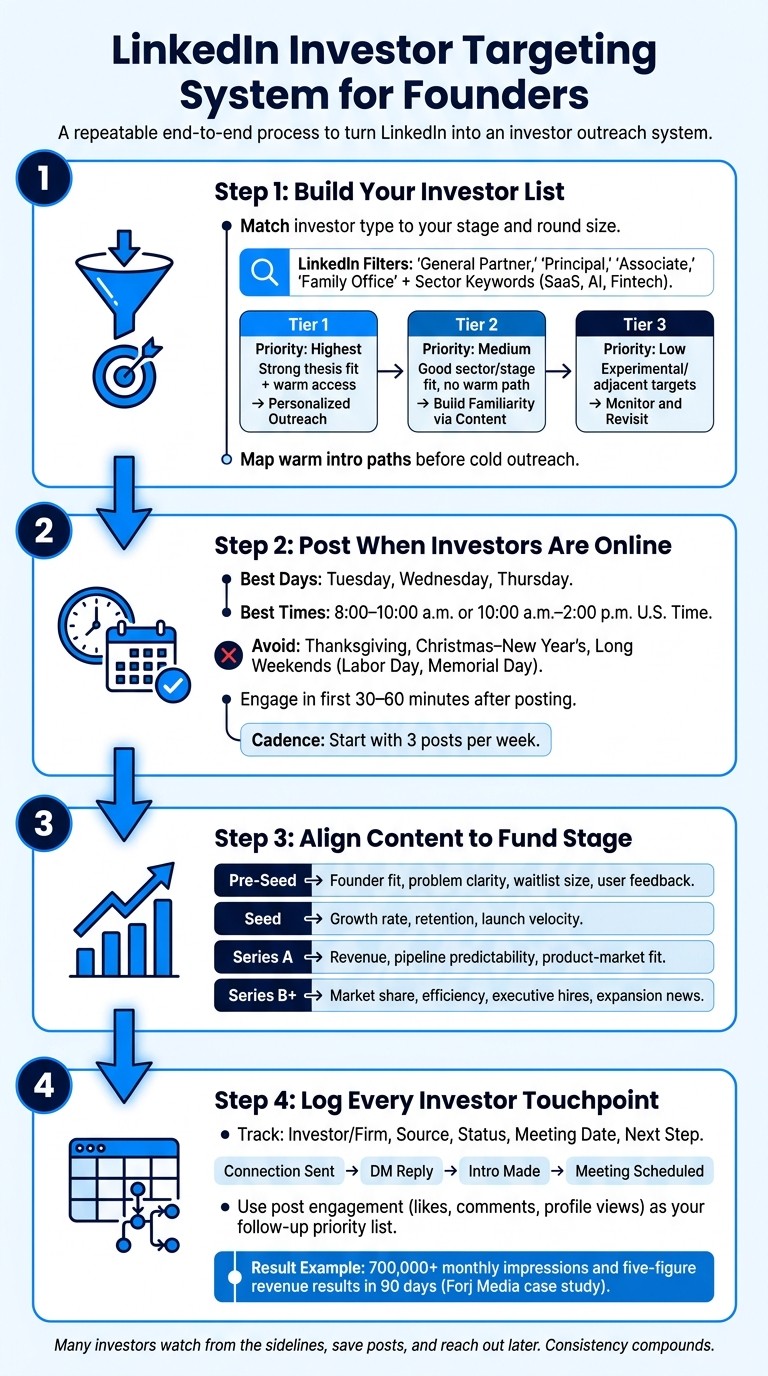
LinkedIn Investor Targeting System for Founders
Build Your Investor Target List Before You Post
Before you post anything, get clear on who you want to reach. A lot of founders skip this step. They publish first, then try to figure out which investors might care. That usually leads to mixed signals and weak follow-up.
Your investor list should shape the whole plan: what you post, how you talk about traction, and who you reach out to after each post.
Match Investor Type to Your Stage and Round Size
Fit matters more than volume. Focus on investors whose stage and sector line up with your round. The right mix shifts as you grow: pre-seed and seed rounds usually need tighter manual targeting, while later rounds can use LinkedIn in a more systematic way. Early rounds also lean more on direct outreach. Later rounds tend to work better when your PMF story is easy to grasp.
Use LinkedIn Filters to Build a Tiered Investor List
Use LinkedIn search with titles and keywords like "General Partner", "Principal", "Associate," and "Family Office," then pair those with sector terms that match your space, like SaaS, AI, or fintech.
Once you have a raw list, sort it into three tiers before you do anything else.
Tier | Criteria | Priority |
|---|---|---|
Tier 1 | Strong thesis fit + warm access | Highest - personalized outreach |
Tier 2 | Good sector/stage fit, but no warm path yet | Medium - build familiarity through content first |
Tier 3 | Experimental targets, adjacent thesis, or early-stage interest | Low - monitor and revisit |
Keep Tier 1 tight. Only include active investors with a clear thesis.
Map Warm Paths and Sharpen Your Positioning
Warm access beats cold outreach, so map the intros you already have to Tier 1 investors. Start with people who are already engaging with your content or checking your profile.
It also helps to match the messenger to the investor. Founders usually connect better with founders and GPs. Technical leads often land better with technical partners.
Your market narrative should stay clear and consistent across your headline, About section, and posts. If an investor lands on your profile and understands the story in a few seconds, you're in a much better spot.
Once the list is set, timing and outreach determine whether investors see it.
Post and Reach Out When Investors Are Most Likely to See It
Once your investor list is in place, timing starts doing a lot of the heavy lifting. Investors often skim a post first and only check the profile after that. If the post goes live at the wrong time, it can miss the people you want to reach.
Post During Midweek US Business Hours
Post from Tuesday to Thursday, ideally from 8:00–10:00 a.m. or 10:00 a.m.–2:00 p.m. U.S. time. That’s usually when investors are active and more likely to see new posts in their feed.
For key traction or fundraising posts, avoid major U.S. holiday weeks. That includes:
Thanksgiving
The week between Christmas and New Year’s
Long weekends like Labor Day or Memorial Day
Those windows tend to be noisy, distracted, or half-offline. If the post matters, don’t burn it on a dead week.
Keep Content Publishing and Investor Outreach Separate
Treat posting and outreach as two different work blocks. After you publish, spend the first 30–60 minutes replying to comments and engaging with people who interact with the post. That early activity helps keep the conversation moving and gives you a cleaner read on who’s paying attention.
Send investor DMs and warm intro requests during business hours, not in the same rush right after posting. Start with three posts per week, then scale only after you’ve tracked engagement and know what’s working.
Use post engagement as your follow-up list. Recent likers, commenters, and profile viewers should come before cold outreach to people on your Tier 1 and Tier 2 target list. Those signals aren’t vanity metrics. They’re your first screen for who to contact next.
Once investors land on your profile, those signals need to hold up.
Build the Signals Investors Check on LinkedIn
Investors often look at your profile and posts before they reply, so each public touchpoint needs to confirm fit fast. When a post starts getting attention, people click through to see if the story holds up. Your profile should line up with the thesis your target investors already care about.
Make Your Profile Easy to Read in Under a Minute
Use a clear headline, a sharp company description, and measurable proof that investors can scan in under a minute. Be specific wherever you can. Vague claims don't do much; exact metrics and concrete examples carry more weight.
Show Strong Signals Through Content and Who Follows and Introduces You
Each post should point to one main strength: traction, market insight, credibility, or team quality. Strong posts make that signal obvious.
Specific hooks, live product proof, and hard metrics tend to beat broad claims.
Use the table below to check whether each post sends one clear signal:
Signal Type | Strong Signal | Weak Signal |
|---|---|---|
Traction | Exact metrics, such as precise minutes saved, and specific customer dialogue | Vague claims like "users love us" with no metric |
Credibility | Named social proof and contrarian, evidence-based POVs | Generic advice or safe posts that echo common industry sentiment |
Clarity | Posts with a clear hook, journey, and payoff | Rambling posts without a clear hook or payoff |
Market Insight | Sharing unusual decisions you actually made, with context | Reposting industry news without a point of view |
Team Credibility | Specific hiring wins or engineering culture moments | Generic "we're hiring" posts with a job link |
Post on a steady cadence, but don't flood the feed. The algorithm doesn't punish frequency; audience fatigue does.
One strong post usually beats several forgettable ones. Get the signals in place first, then your outreach has something solid to land on.
Match Content to Fund Stage and Track Investor Pipeline Movement
Align Content With Pre-Seed, Seed, Series A, and Series B+ Expectations
Once your profile and posts show a clear fit, line up each post with the stage and thesis of the investors you want to reach. That part matters more than a lot of founders think.
Pre-seed investors usually look for founder-market fit, a sharp read on the problem, and early proof that people care. Seed investors want traction. They want to see that your product, messaging, and go-to-market are starting to click. Series A investors look for product-market fit that holds up under scrutiny, plus a pipeline you can forecast with some confidence. Series B+ investors want growth that’s efficient, along with proof that the company can expand and lead its space.
One thing throws people off: returns often lag. A strong investor conversation may not come from the post you published yesterday. It may come months later, after someone has watched your content from the sidelines.
Fund Stage | Primary Goal | Metrics to Highlight | Content Formats |
|---|---|---|---|
Pre-Seed | Validation | Waitlist size, user feedback, founder story | Building in public logs, problem deep-dives, future-state hooks |
Seed | Traction | Growth rate, retention, launch velocity | Product launch announcements, before-and-after hooks |
Series A | Scale | Revenue, pipeline predictability, product-market fit | Case studies, scalable system breakdowns |
Series B+ | Market leadership | Market share, executive hires, efficiency | Contrarian POVs, named social proof, industry vision, expansion or acquisition news |
Stage-specific posts matter only if you track which investors move from view to reply to meeting. Otherwise, you’re posting into the void and hoping something sticks.
Track Replies, Intros, and Meetings Like a Sales Pipeline
LinkedIn activity matters only if you know where it leads. A profile view, DM reply, intro, or booked meeting from a post is a signal. If you don’t log it, you lose it.
Keep the tracker tight. Focus only on investors from your target list so you can see which posts warm up the people you actually want to meet. A simple CRM-style log is enough, as long as you update it after each LinkedIn interaction.
Field Name | Description |
|---|---|
Investor/Firm | Name of the individual and their venture fund |
Source | Where the lead originated (e.g., LinkedIn post engagement, DM, warm intro) |
Status | Current stage in the funnel (e.g., Connection Sent, DM Reply, Meeting Scheduled) |
Meeting Date | Scheduled date for the next conversation |
Next Step | Specific action item (e.g., Send deck, follow up in 2 weeks) |
A Forj Media client using a Series A-focused content strategy drove 700,000+ monthly impressions and multiple five-figure revenue results within 90 days by using signal-based outreach to turn LinkedIn engagement into direct conversations. That kind of tracker helps you spot which posts lead investors to reply and book time.
Conclusion: A LinkedIn Fundraising System Founders Can Repeat
The system is pretty simple: target the right investors before you post, build proof points for the stage you’re raising at, stay consistent with your cadence, track every reply, intro, and meeting in one place, and turn engagement into direct conversations.
"Every post you publish is a signal. Not everyone who sees it will act immediately. But the right people will bookmark your content, watch from a distance, and decide that when they're ready to have a convo, you're the one they'll go to." - Matt Huang, Founder, Forj Media
Founders who treat this as a repeatable system, instead of a one-off sprint, tend to build investor relationships well before they need to raise.
FAQs
How many investors should I target first?
Start selective, not broad. Put your energy into investors who match your funding stage, and build a steady presence that helps people trust you.
Investors may read your posts, watch your interviews, or see your updates long before they ever reach out. That means your job isn’t to chase a big number. It’s to become the founder they remember when the timing feels right.
So skip the spray-and-pray approach. Go for quality and fit over any set target.
What should I do if investors view my profile but don’t reply?
Don’t get discouraged or stop outreach too soon. Content ROI often takes time, and many investors follow founders quietly before they decide to engage.
Keep publishing consistent, high-quality content to build trust and credibility. If someone has engaged with your content or viewed your profile, you can use signal-based outreach to start a personal, non-spammy conversation. Forj Media helps founders build the executive presence that keeps them top of mind.
How long should I track LinkedIn activity before judging results?
Don’t judge the results too soon. Content ROI often doesn’t show up until month 4 or 6, especially in B2B with long sales cycles. A lot of founders decide content isn’t working after only 30 days, and that’s usually way too early.
Start with a steady cadence, like three posts per week, then track engagement for at least one month before you change anything. Think of LinkedIn as a long-term experiment, not a tool that delivers instant conversions.