Personal Branding Agency vs. In-House Team: Key Differences
Social Media Marketing
Compare personal branding agencies and in-house teams for LinkedIn: costs, speed, quality, scale, and founder time trade-offs.

If you need LinkedIn output soon and have limited founder time, choosing a LinkedIn ghostwriting agency is usually the better pick. If you want tighter control and plan to build this function inside the company, an in-house team often fits better.
I’d boil the choice down to this:
Agency: lower founder time, faster launch, fixed monthly fee
In-house: more control, more internal context, slower setup
Main trade-offs:cost, time to start, content quality, scale, and how much work lands on the founder
One stat says 81% of executives think a visible CEO matters to company reputation. So this choice is not small. It affects how soon you show up, how steady your posting is, and how much strain it puts on your team.
Marketing Agency vs In-House Team: What Actually Works in 2025
Quick Comparison
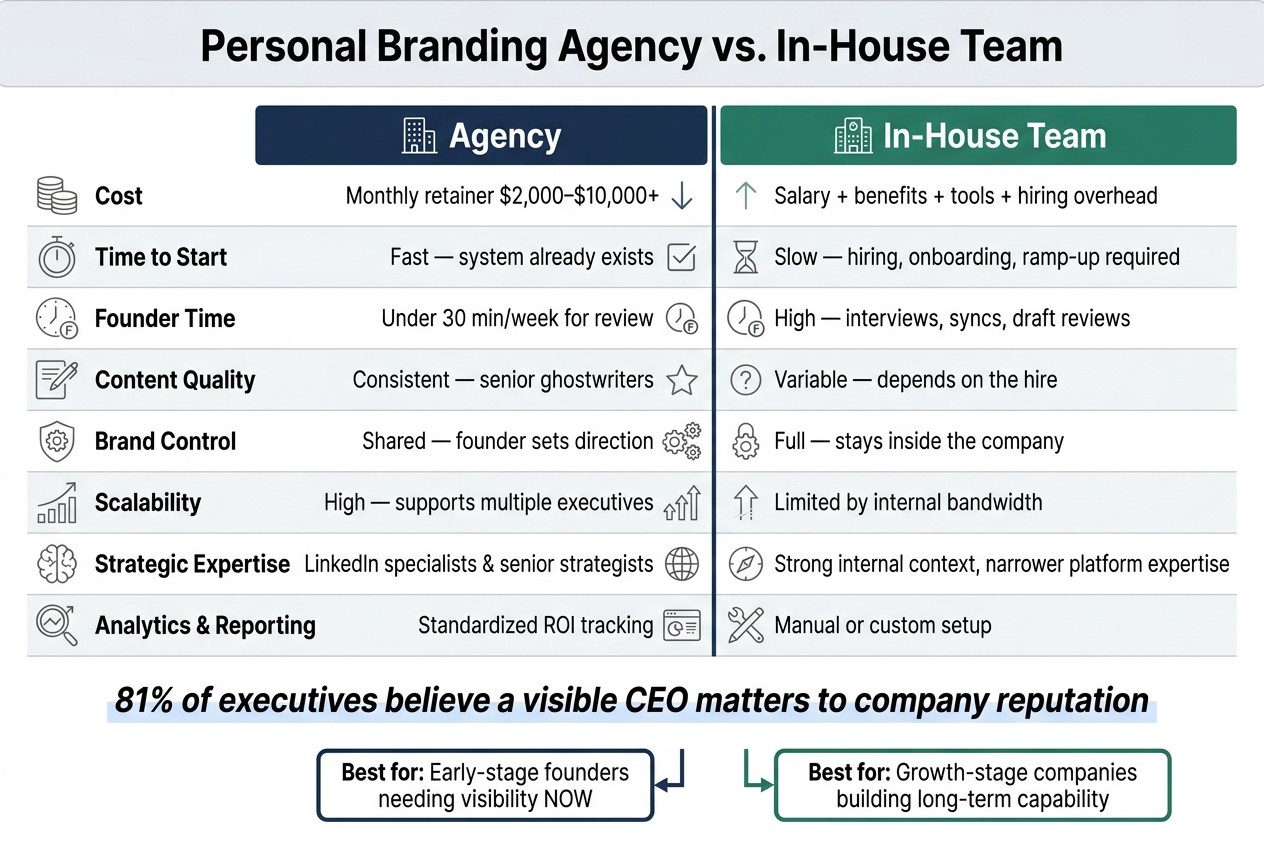
Personal Branding Agency vs. In-House Team: Key Differences at a Glance
Factor | Agency | In-House Team |
|---|---|---|
Cost | Monthly retainer, often $2,000–$10,000+ | Salary, benefits, tools, and hiring cost |
Time to start | Faster, since the system already exists | Slower, due to hiring and ramp-up |
Founder time | Often under 30 minutes per week for review | More meetings, reviews, and back-and-forth |
Quality | More steady output from experienced writers | Depends a lot on the hire |
Control | Shared between founder and partner | Stays inside the company |
Scale | Easier to support more than one executive | Limited by team bandwidth |
My simple take: if you’re hiring, fundraising, or need visibility now, an agency often gives you more leverage. If you’re building for the long term and want the work owned inside the business, in-house can make more sense.
Below, I’ll break down where each option fits best without repeating the full article.
What each option includes
What a personal branding agency does
A personal branding agency builds the founder's content system from start to finish. It usually begins with strategy and positioning: defining content pillars, voice, and messaging. After that, the agency takes over idea sourcing through bi-weekly syncs with the founder, trend monitoring, and review of customer calls.
On the production side, agencies often deliver a steady weekly LinkedIn program. That can include ghostwriting, hooks, visuals, and video scripts. They also manage drafting, revisions, approvals, and scheduling. Higher-tier packages may add profile optimization, comment replies, and engagement follow-up so post interest turns into actual conversations.
The big draw is simple: you get a repeatable system without needing much founder time.
What an in-house team handles
An in-house team brings one thing an agency usually can't match: direct access to what’s happening inside the company. That close connection often leads to better accuracy and a more natural voice.
The tradeoff is workload. The same content work stays inside the business, which means the team has to carry the execution. A working in-house setup usually needs people covering strategy, writing, design, publishing, and analytics. The team still has to gather insights, draft posts, revise them, and get approvals over the line.
"Executive Content is a great example of 'easier said than done'... Anyone who says 'let's just have our CEO post a couple times / week on LinkedIn' has never actually tried to do it for more than a few weeks." - Matt Huang, Founder & CEO, Forj Media
Here’s how the work usually gets divided:
Task | Agency | In-House Team |
|---|---|---|
Strategy | Content pillars, platform-specific optimization, ROI measurement | Brand alignment, internal stakeholder coordination |
Sourcing | Executive interviews, trend research, customer call mining | Direct access to internal data and product updates |
Production | Ghostwriting, hook design, video editing, formatting | Writing, internal design resources, filming |
Operations | Scheduling, engagement, lead-gen tools | Manual posting, community management |
Approvals | Managing the review loop | Final sign-off, legal/PR compliance checks |
The core difference comes down to where the work lands. Agencies give you more speed with less internal involvement. In-house teams give you more ownership, but they usually move slower.
Main differences that affect the choice
These are the tradeoffs that matter most for LinkedIn-driven founder visibility.
The table below lays out the big ones. In practice, the main decision points are cost, speed to launch, and how much founder time each setup eats up.
Factor | Personal Branding Agency | In-House Team |
|---|---|---|
Cost structure | Monthly retainer ($2,000–$10,000+) | Salary, benefits, tools, and overhead |
Speed to launch | Fast - uses proven editorial systems | Slower - requires hiring, onboarding, and process setup |
Strategic expertise | Senior strategists and LinkedIn experts | Strong internal context, but platform expertise may be narrower |
Content quality | Consistent - interview-driven, senior writers | Variable - depends on the hire |
Brand control | Shared - founder sets direction, agency executes | Full - team operates inside the company |
Scalability | High - can scale across multiple executives | Limited by internal bandwidth |
Analytics & reporting | Standardized reporting and ROI tracking | Manual or custom setup |
Founder time demand | Low - less than 30 minutes per week for feedback | High - interviews, approvals, and reviews consume time |
Cost, launch time, and founder time
Agency pricing usually comes as a fixed monthly retainer. In-house costs look simpler at first, but they stack up fast: salary, benefits, tools, and hiring overhead all come with the package.
Launch speed is another clear split. Agencies move faster because the editorial system is already in place. That means you can start posting sooner, which leads to earlier LinkedIn visibility. An internal hire needs time to ramp up, learn the founder's voice, and help build the process from scratch.
The hidden cost is founder time. And honestly, this is where a lot of teams get tripped up.
High-end agencies keep founder involvement under 30 minutes per week for feedback and approvals. That’s light. In-house teams usually need more direct input through interviews, syncs, draft reviews, and stakeholder back-and-forth. A little here and a little there doesn’t sound like much, but over weeks and months, it adds up.
Beyond speed and cost, the next issue is how much expertise, control, and scale you want.
Expertise, quality, control, and scale
This is where the decision shifts from day-to-day logistics to a bigger company call.
Agencies bring LinkedIn-specific strategy and senior writing talent that can be tough to build inside a company. In-house teams usually know the business better, but they may need time to build the same level of platform know-how.
That said, internal teams do have one clear edge: access. They can pull from product updates, customer calls, and internal discussions with less friction. That direct line can sharpen accuracy and make the voice feel closer to the founder. Agencies can close much of that gap with structured interviews and a repeatable editorial workflow, but there’s still one more step between the founder and the final draft.
Scale matters too. Agencies can run the same system across multiple executives without adding headcount. Internal teams are more limited by bandwidth, approvals, and review cycles.
Which option fits your stage
The right setup comes down to your runway, hiring plans, and how much content work your team can handle. Once you see those trade-offs, stage becomes the fastest way to narrow the choice.
Best for early-stage founders who need visibility soon
If you're in the middle of fundraising or hiring, waiting 3–6 months to hire and train an internal team usually isn't realistic. An agency gives you a done-for-you system, so you can start posting sooner. That kind of speed is tough to match when you're also trying to close a round or fill key roles.
Best for growth-stage companies building internal capability
Once visibility starts working, the next issue is ownership. As your team grows and more leaders need a public presence, the equation shifts.
An in-house hire makes the most sense when:
Multiple leaders need to post
Internal knowledge can be turned into a repeatable system
You need strategy, writing, and someone who knows how the company works
The right in-house person builds company knowledge over time, especially if you want several executives posting on a steady basis.
Best for founders who want long-term thought leadership
If you're set on posting 3–5 times per week for the long haul, the main issue is who owns consistency. That amount of output is hard to keep up internally unless someone is dedicated to it full time.
If cutting founder time and keeping publishing steady matter more than managing everything inside the company, an external partner usually has the edge. At that point, the real question is simple: which setup gives you the most leverage for the least founder time.
Conclusion: The right choice is about leverage, not only cost
After looking at cost, speed, control, and scale, one factor stands above the rest: founder bandwidth. In practice, cost often matters less than leverage. The better choice is the one that gets you the most visibility for the least amount of founder time.
An agency swaps dollars for speed and hands-on execution help. An in-house team swaps hiring time and setup work for tighter control and stronger internal ownership.
If you need a LinkedIn presence right now and can't wait through a long hiring cycle, an agency clears the operational jam. If you're building for the long haul and want closer brand control, in-house tends to make more sense over time.
Choose based on your stage, your hiring pressure, your fundraising timing, and how often you need to post on LinkedIn. The right model matches your stage, your bandwidth, and your timeline for results.
FAQs
How do I know when to switch from an agency to in-house?
Switch when content has to plug into your day-to-day work in a deep way. That usually means things like real-time product updates, private company data, or executive messaging that’s so specific it gets messy when handled outside the company.
An in-house team tends to make more sense when content is a permanent part of how your brand grows. At that point, you’re not just publishing now and then - you’re building a core function. But that also means taking on hiring, training, and editorial oversight, while still keeping quality high and your brand voice accurate.
What results should I expect from LinkedIn personal branding?
LinkedIn personal branding can strengthen authority, pipeline, fundraising, and recruiting. With a steady presence, you get to shape your own story and speak straight to your audience instead of depending on old-school media.
Common results include more monthly impressions, follower growth, inbound sales leads, and funding opportunities. The goal isn’t going viral. It’s publishing consistent, substantive content that builds trust and keeps you in front of investors and top talent.
Can a small in-house team handle executive content well?
A small in-house team can support executive content. But keeping up a strong LinkedIn presence is often hard.
Why? Because it takes steady research, tight voice alignment, content design, video production, analytics, and constant coordination around a packed executive calendar.
Without a specialized workflow that the team can repeat week after week, things tend to slow down. Publishing stalls. Revision rounds drag on. And the content can start to sound generic instead of sounding like the founder.