Low LinkedIn Visibility: Causes and Simple Fixes
Social Media Marketing
Fix low LinkedIn reach by tightening profile signals, posting cadence, hooks, formatting, and early engagement.

If your LinkedIn posts get low reach, the problem is usually not the idea. It’s your profile signal, posting rhythm, topic choice, and early engagement.
I’d sum it up like this: LinkedIn tends to push posts that match a clear area of expertise, show up on a steady schedule, and get activity in the first 60 to 90 minutes. When those signals are weak, posts often stall, profile visits stay low, and the right people never see your work.
Here’s the short version:
Fix your positioning: I’d make sure your headline, About section, and posts all point to one clear topic.
Post on a steady rhythm: For most executives, 1–2 posts per week is enough.
Pick narrower topics: Specific lessons, data, and first-hand takes tend to do better than broad advice.
Improve the first lines: If the hook is weak, people won’t stop scrolling.
Format for mobile: Short paragraphs and spacing help people keep reading.
Work the first hour: Early comments and replies can shape reach fast.
Check the right metrics: I’d watch impressions, saves, profile views, and audience job titles each week.
A few numbers stand out. If engagement is flat in the first 60–90 minutes, reach often slows down. And about 40% of a post’s total reach can happen in the first hour. That means small fixes at the start of the process can change results more than posting more often.
The core point: I’d stop guessing and tighten the basics first. Clear expertise, steady posting, better hooks, and close review of analytics usually do more for visibility than writing more posts.
The 3 biggest causes of low LinkedIn reach
Low LinkedIn reach usually comes down to three things: unclear positioning, inconsistent posting, and topics that miss the mark.
Vague executive positioning makes your expertise hard to read
LinkedIn looks at your headline, About section, and experience before it decides where your posts should go. If those profile signals don’t point to one clear area of expertise, LinkedIn has a harder time matching your content with the right people.
That’s why specificity matters so much. A headline like "CEO | Building the future of work" sounds polished, but it tells the algorithm almost nothing. "CEO at [Company] | Helping mid-market ops teams cut manual reporting" is much clearer. It gives LinkedIn a direct clue about what you do and who should care.
Your profile and your posts should say the same thing. If they don’t, reach often drops - not because the post is weak, but because the signal is fuzzy.
When your profile lacks clarity, every post starts a step behind.
Posting without a schedule breaks your momentum
Irregular posting can drag down reach fast. A one-week gap often becomes two weeks, then a month of silence. Consistency helps LinkedIn learn who should see your content, and it helps your audience know when to look for your ideas.
For most busy executives, one to two focused posts per week is a pace they can keep up with. That’s usually enough. Steady beats high volume.
There’s another issue here too: when you post off and on, it gets harder to build early engagement. And on LinkedIn, those early likes, comments, and saves can make a big difference.
Off-target topics miss the audience you want to reach
Generic motivation and broad business advice often fall flat because they don’t show the right people why you matter. LinkedIn tends to favor specific posts led by actual expertise, like industry breakdowns, operator lessons, and clear frameworks.
The best topics for founders and tech executives are narrow, rooted in real experience, and shaped by a clear point of view. That’s the kind of content people save, share, and comment on with substance. Those are the signals that can push a post past your immediate network.
Even a strong idea can lose steam if the hook is weak or the format doesn’t pull people in.
Why good ideas still get skipped in the feed
Even the right LinkedIn content can flop if the post feels hard to enter or hard to scan.
Weak opening lines lose readers before they start
People decide fast. Your opening has to earn attention right away.
Most readers only see the first few lines before they choose to stop or keep going. That means those lines need actual substance, not a vague teaser.
A good opener usually starts with one of three things:
proof you did the work
a clear result
a personal story
That gives people a reason to stay with you.
If the hook does its job, the next test is readability.
Dense paragraphs are hard to scan on mobile
A paragraph that looks fine on desktop can turn into a solid block on mobile. And once it feels like work, many readers leave.
The platform also tracks dwell time, which is the amount of time someone spends on your post. Dense formatting hurts that signal in a direct way. If the post looks tough to read at a glance, people move on before that time can even build.
The fix is simple: keep paragraphs to two or three lines, leave space between them, and use plain language. Emojis can help too when used lightly. They can act like visual markers that guide the eye down the post.
Make the post easy to scan without watering it down.
Formatting shapes whether the post gets read.
Visibility depends on participation and profile alignment
Once a post is easy to read, distribution comes down to two things: who interacts with it and whether your profile lines up with the topic. Posting on a steady rhythm helps, but it doesn't do the whole job. Reach tends to improve when your profile, your posts, and your activity all point to one clear area of expertise.
Low interaction limits how far your posts travel
The first 60 to 90 minutes matter most. LinkedIn delivers 40% of a post's total reach within the first hour. That early window carries a lot of weight.
When you reply to comments, you show LinkedIn that the post has an active discussion around it. That can help lift engagement. It also helps to comment on 10–15 relevant industry posts per day. Skip the quick “great post” type of replies. Thoughtful comments tend to do more work.
This doesn't need to turn into a full-time job. These are low-effort habits. A handful of focused replies each day is enough to keep the signal active.
A mismatch between your profile and your posts confuses new visitors
Participation helps, but profile alignment decides whether that engagement builds over time.
If your content doesn't match your stated expertise, reach drops. A simple gut check works well here: compare your headline, About section, and experience with your last five posts. If a new visitor can't tell what you do and who you help within a few seconds, tighten that match.
How to find what is working and act on it
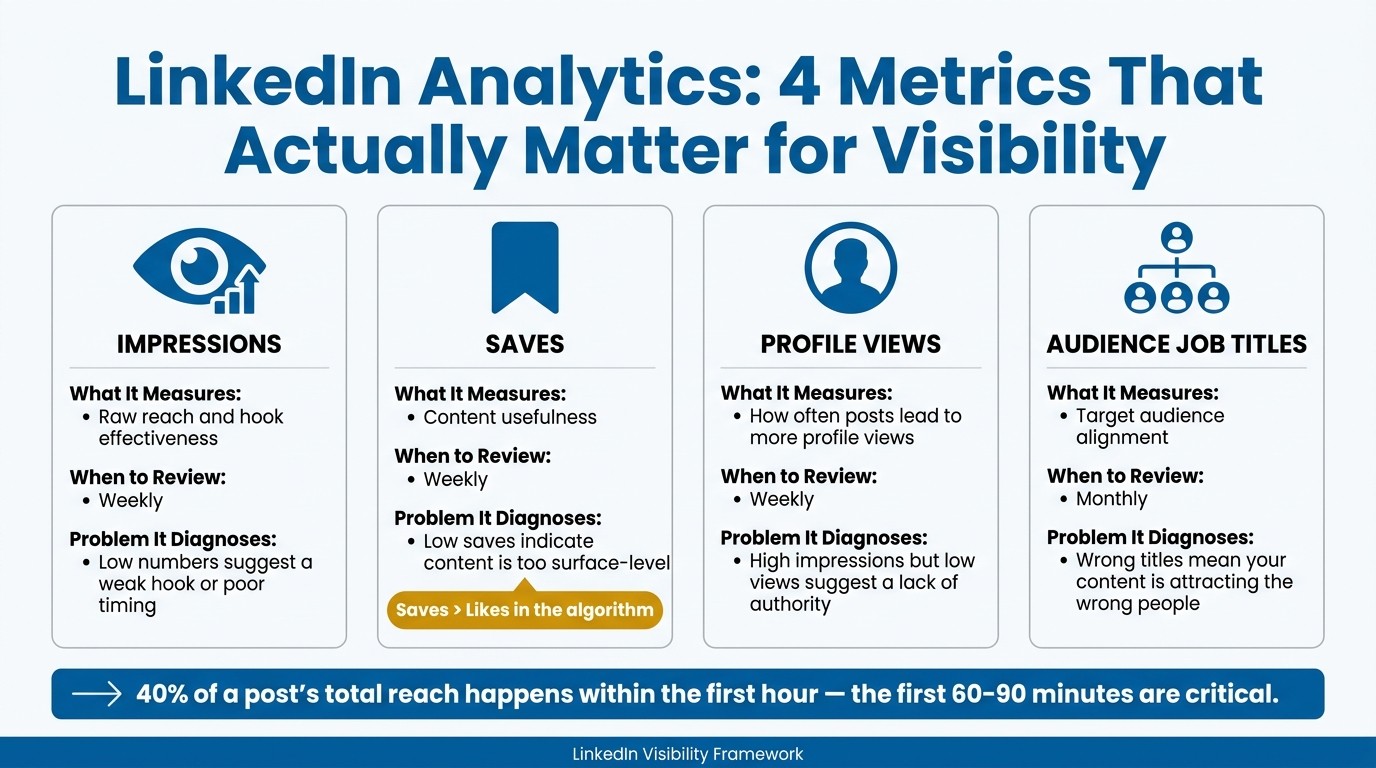
LinkedIn Analytics: 4 Metrics That Actually Matter for Visibility
Stop guessing. Use LinkedIn analytics to see which posts earn reach, saves, and profile views, then do more of the topics that pull in the right people. Once the basics are in place, analytics show what is actually getting attention: the topic, the hook, and the format.
Use LinkedIn analytics to track reach, relevance, and profile lift
Most executives look at impressions and stop there. That’s the wrong move.
Impressions tell you how many people saw a post. Saves tell you whether it was useful enough for someone to come back to later. And saves matter more than likes in the algorithm because they signal content worth revisiting.
The table below shows the four metrics that matter most and when to check them:
Metric | What It Measures | When to Review | Problem It Diagnoses |
|---|---|---|---|
Impressions | Raw reach and hook effectiveness | Weekly | Low numbers suggest a weak hook or poor timing |
Saves | Content usefulness | Weekly | Low saves indicate content is too surface-level |
Profile Views | How often posts lead to more profile views | Weekly | High impressions but low views suggest a lack of authority |
Audience Job Titles | Target audience alignment | Monthly | Wrong titles mean your content is attracting the wrong people |
Each metric points to a different cause covered earlier. Impressions show hook strength. Saves show usefulness. Profile views show whether your profile lines up with the interest your posts create. Job titles show audience fit.
If your audience job titles don’t match the people you want to reach, posting more won’t solve the problem. That’s a relevance issue, not a volume issue.
A simple weekly checklist for executives
Use these checks to turn analytics into weekly decisions:
Analytics review: Look at saves and audience job titles to make sure your content is reaching the right people.
Profile check: See whether your headline keywords match the audience behind your best engagement.
Hook audit: Review the first 4–6 lines of your next post. If they don’t promise a clear payoff, rewrite them.
Cadence check: Stick to a weekly posting rhythm you can keep up.
Engagement block: Set aside 15 minutes to leave thoughtful comment replies.
Idea capture: Write down one content idea from a customer conversation or an industry change this week.
Clarity and consistency beat the occasional burst.
FAQs
How long should I test a new LinkedIn strategy?
Commit to a new strategy for at least three months before you judge it.
A lot of executives pull the plug after 30 days because they expect instant ROI. That’s usually too soon. Content often starts to pay off in month four, month six, or even later.
Set a baseline posting cadence, track engagement, and let the data guide your next moves. Then adjust your approach based on what you learn instead of stopping before the results have a chance to show up.
What should I post if I cover more than one topic?
If you cover more than one topic, treat your profile like a product with a clear publishing rhythm. Each post should lean on one of three things:
what you’ve experienced
what you’ve learned
what you can teach through a story
On LinkedIn, relevance matters more than broad reach. So every post should help your ideal audience fix a real problem, not just fill the feed.
Then watch the numbers for a month and adjust based on what people respond to. That’s usually where the pattern starts to show.
Which metric matters most if reach is low?
If your reach is low, put relevance ahead of impressions. On LinkedIn, posts tend to do better when they line up with professional interests and get people talking. That’s why it makes more sense to judge success by business results - like inbound leads or booked meetings - than by raw view counts.
When you review performance, pay close attention to high-intent signals such as saves, reposts, and comments from second- or third-degree connections. Those actions often help your post travel past your direct network and into new circles.