How to Turn Your Expertise Into LinkedIn Content
Social Media Marketing
Turn work moments into LinkedIn posts: choose 3-5 pillars, capture ideas from calls and meetings, use hook→context→insight→takeaway, post 2-3x/week.

You do not need more ideas. You need a simple way to turn your work into posts. If I want LinkedIn content that gets attention, I focus on specific decisions, clear outcomes, and one lesson per post.
Here’s the short version:
I pick 3 to 5 content pillars tied to my role
I save post ideas from calls, meetings, hires, launches, and customer feedback
I turn each idea into one post with one point
I use a simple flow: hook → context → point of view → takeaway
I post 2 to 3 times per week and batch drafts in about 30 minutes
A plain post about a real hiring call, a product tradeoff, or a sales objection will usually do more than broad advice. Why? Because specific details show judgment. A line from a customer call, a product metric, or a hiring choice gives people something clear to remember.
If I want this to work, I keep my content centered on a small set of themes:
Product decisions
Hiring and team building
Go-to-market lessons
Founder story
Industry point of view
I also match the post type to the goal:
Post type | Best for | What I share |
|---|---|---|
Founder story | Awareness | One moment, then what changed |
Hiring lesson | Recruiting | One hiring choice and the result |
Product insight | Customer trust | User behavior, feature usage, or a metric |
Framework | Teaching | A step-by-step way I think |
Contrarian take | Reach | A common belief and why I disagree |
Industry prediction | Market position | A pattern I see and where I think it leads |
A few numbers make this easier to act on:
3 to 5 content pillars
1 idea per post
2 to 3 posts each week
30 minutes a week to batch drafts
The main idea is simple: I do not invent LinkedIn content from scratch. I pull it from work I already did, write it in plain English, and stay consistent.
That is the whole system.
LinkedIn Content Strategy for Founders - The 5-Post Framework
Audit Your Work and Build a Content Idea Bank
Use your content pillars to sort the work you already do. Think of them as simple filters for every note, call summary, or half-formed idea you save.
Turn Recent Work Into Clear Content Themes
Look at recent work through the pillars you picked: product, hiring, go-to-market, founder story, and industry perspective. Each one can reveal a trade-off, a call you had to make, or a point of view worth putting into a post.
The nice part is that these categories line up with work already on your plate. Product insights often come from shipping calls and roadmap friction. Leadership lessons tend to come from hiring choices and team pivots. Market shifts show up in patterns across customer calls and industry news. And if the same customer objection keeps coming up, that's already a post idea waiting to happen. Once you spot the pattern, turn it into one clear angle.
Turn One Experience Into One Post
Keep it simple: note what happened, why it mattered, and what belief changed because of it. One experience. One lesson. One post.
Tanay Kothari, CEO of Wispr Flow, built posts around specific, unusual decisions he actually made - like telling his team to stop growing revenue - paired with the reasoning behind the call. That level of detail is what made the posts work. Save that angle in your vault so it's there when you're ready to write.
Keep a Running Content Vault
Write the idea down in one place right after the call, meeting, or conversation. Do it while it's still clear in your head, not later when the details start to fade.
Structured bi-weekly syncs and current industry news can keep that vault full on a steady basis. That changes the writing process in a big way. When it's time to post, you're shaping and trimming what you already have, not staring at a blank page.
Turn Expertise Into LinkedIn Post Formats That Fit Executive Brands
Once you have raw ideas, pick the format based on the result you want: reach, credibility, or recruiting. A simple structure that works well is Hook, context, insight, takeaway. The hook earns attention in the first few lines. The context gives just enough background. The insight is your actual point of view. The takeaway shows the reader what to do with it.
Stick to one idea per post and keep paragraphs short. The format should match the job of the post, not just the topic.
Founder Stories, Hiring Lessons, and Product Insights
Strong founder posts focus on one moment, not a big life lesson. One useful approach is the Time Jump hook: start with where you were 2 or 3 years ago, shift to today, and let the contrast do the work. That gap creates tension and gives the post shape.
Details matter here. Use exact numbers, mention a named feature, or include the actual line a customer said on a call. Those specifics can turn a rough note into a post that hits.
Hiring lessons follow the same idea. Instead of writing, "Here's what I look for in a great hire", write about one hiring call, what changed after it, and the trait that mattered most. That feels grounded because it is.
Product insight posts are strongest when they come from actual customer behavior. Show how people used a feature, which metric moved after a decision, or what a launch taught the team when you used your own product. That kind of post says more than a generic opinion ever could.
Contrarian Takes, Frameworks, and Industry Predictions
A contrarian take means saying the quiet part out loud. Start with the assumption most people hold, explain why your experience points the other way, and offer a better frame. The trust comes from patterns you've seen firsthand.
Frameworks are one of the easiest post types to reuse. If you have a repeatable way to think through hiring, pricing, or roadmap tradeoffs, give it a name and walk people through it step by step. That makes your thinking easier to follow and easier to remember.
Industry predictions work best when they're tied to something you can point to. That could be a pattern across customer calls, a competitor move, or a shift in buyer behavior. A forecast backed by signals lands better than a vague guess.
Comparison Table: Which Content Angle to Use for Each Goal
Use this table to match each content angle to the result you want.
Content Angle | Main Goal | Typical Structure | When to Use | Authority Built |
|---|---|---|---|---|
Founder Stories | Awareness and relatability | Time Jump (Past → Present) | Milestones, pivots, early mistakes | Personal resilience |
Contrarian Takes | Credibility and differentiation | Common belief → Why it's wrong → New framing | Challenging industry assumptions | Thought leadership |
Frameworks | Education and utility | Step-by-step solution | Recurring customer objections | Subject matter expertise |
Hiring Lessons | Leadership and culture | Specific decision → Outcome → Key trait | After key hires or team shifts | Management judgment |
Product Insights | Proof of work and conversion | Specific metric or behavior + using your own product | Feature launches, customer behavior shifts | Technical and product expertise |
Industry Predictions | Market positioning | Observable pattern + clear forecast | Responding to news or competitor moves | Strategic foresight |
Build a Repeatable LinkedIn Content System
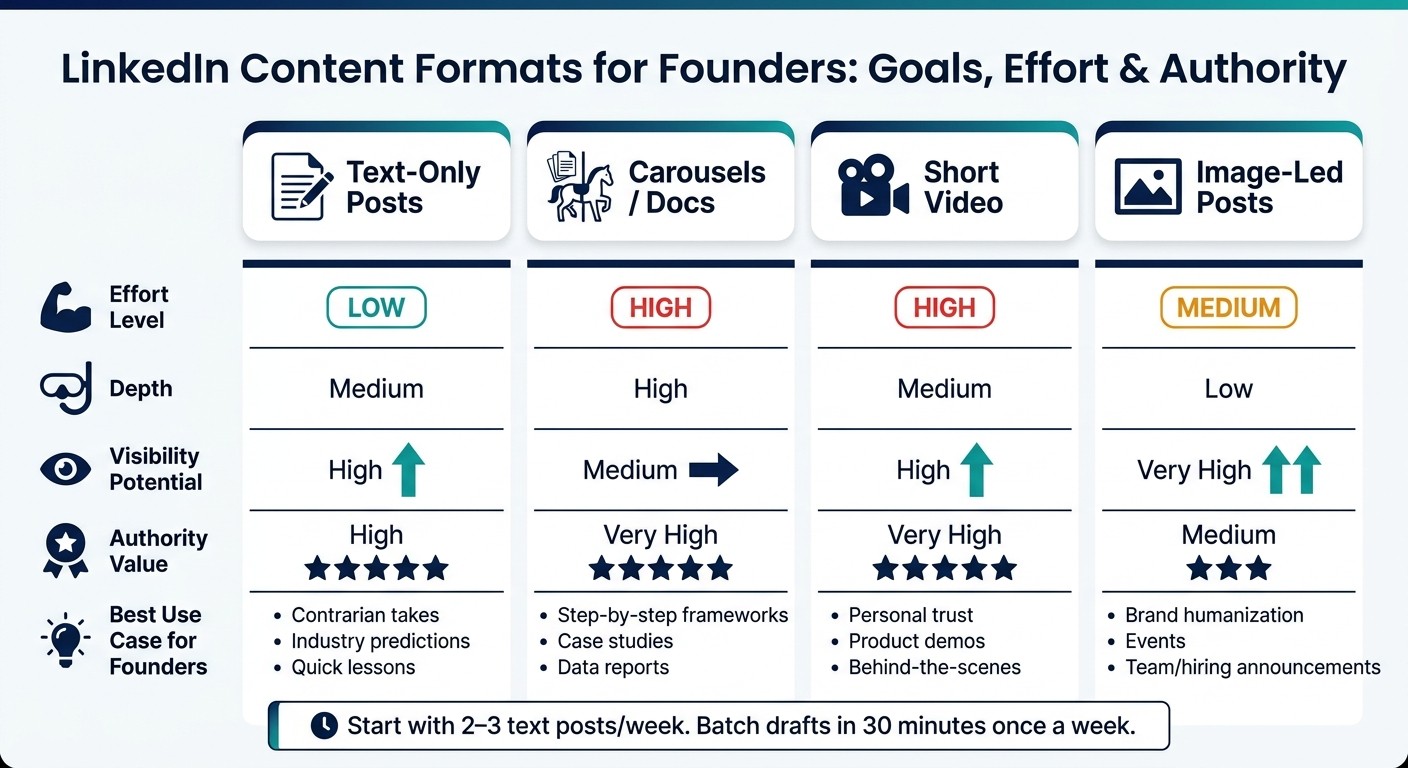
LinkedIn Content Formats for Founders: Goals, Effort & Authority
Formats only pay off when you can stick with them on a schedule that fits your week. Once you have a few strong content angles, the next move is simple: turn them into a posting rhythm. At that point, two choices matter most - who you want to reach and how often you can post.
Match Content to the Audience You Need to Reach
Define your audience by what matters to them. Investors, candidates, and buyers don’t look for the same signals.
If recruiting is the top goal, focus on hiring lessons, team choices, and what day-to-day work on your team looks like. If you're working on fundraising, founder stories can show market awareness and sharp thinking. If the goal is customer trust, product insights and clear frameworks tend to do the heavy lifting because they show how you think and how you solve problems. And if you want broader market visibility, contrarian takes usually travel the farthest.
Pick one or two audiences and let that shape your mix. Then use that priority to decide which formats deserve a regular spot in your schedule.
Pick a Small Set of Formats and a Weekly Cadence
Start with 2 to 3 posts per week, with most of them as text posts. They take the least time to produce and are one of the easiest ways to stay consistent while still getting strong visibility on LinkedIn. If you have more room in your schedule, add a carousel or a short video.
Capture ideas as they happen, then batch them once a week. Set aside 30 minutes once a week to draft several posts in one sitting. Batching is faster than writing one post at a time, and it gets rid of the daily scramble over what to publish.
Comparison Table: Post Formats by Time Required and Business Value
The best format is the one you can repeat without dragging down the rest of your week.
Post Format | Effort Level | Depth | Visibility Potential | Authority Value | Best Use Case for Founders |
|---|---|---|---|---|---|
Text-only Posts | Low | Medium | High | High | Sharing contrarian takes, industry predictions, or quick lessons. |
Carousels / Docs | High | High | Medium | Very High | Step-by-step frameworks, deep-dive case studies, or data reports. |
Short Video | High | Medium | High | Very High | Building personal trust, product demos, or behind-the-scenes clips. |
Image-led Posts | Medium | Low | Very High | Medium | Humanizing the brand, event highlights, or team/hiring announcements. |
A small system you can repeat beats posting in random bursts. It also makes next week’s post a lot easier to write.
Conclusion: From Subject-Matter Expert to Consistent LinkedIn Presence
Once you have a few pillars, a handful of go-to formats, and a simple posting rhythm, this stops feeling random. It becomes something you can repeat. Start with what you know, pull ideas from the work already on your calendar, choose a small set of pillars, and post on a schedule you can stick to.
On LinkedIn, credibility comes from specific judgment, not generic advice. That’s the difference between a post people scroll past and one they remember. The hard part isn’t coming up with big ideas out of thin air. It’s noticing the post-worthy moment while the work is still happening.
That means training yourself to spot content moments in sales calls, team decisions, and product tradeoffs, then saving them before they vanish. A quick note after a call or a rough draft right after a meeting can go a long way.
A repeatable system also keeps posting efficient and tied to what you want from the platform, whether that’s audience growth, recruiting, or fundraising.
Key Takeaways to Put Into Practice This Week
Here’s the simplest way to apply this this week:
Pick your content pillars. Choose 3 to 5 topics tied directly to your role and goals. Don’t pick what sounds impressive. Pick what you know and what your target audience needs to see.
Capture one lesson from this week’s work. It could be a decision you made, a question a prospect asked, or a tradeoff you had to make. Write it down now, while it’s still clear.
Draft two posts using a repeatable format. Try a founder story, a contrarian take, or a short framework. Keep each post centered on one clear insight.
Set your cadence. Block time once a week and treat it like a standing meeting you don’t cancel.
Consistency turns expertise into a LinkedIn presence people remember, built on founder stories, contrarian takes, frameworks, hiring lessons, product insights, and predictions.
FAQs
How do I choose the right content pillars?
Choose content pillars by matching your business goals to what your audience needs.
Start with your ideal customer profile. Then map out their biggest challenges, questions, and objections. The answers to those pain points become your core content ideas.
From there, tighten those ideas with input from day-to-day work. Pull from sources like:
Sales calls
Industry trends
Team discussions
That’s usually where the good stuff lives. You’ll hear the same concerns come up again and again, and those patterns can shape content people already care about.
It also helps to build your pillars around your point of view. What do you believe that others in your space miss? What do you explain better than most? That angle gives your content a clear voice instead of making it sound like everyone else.
As you shape each pillar, make sure it ties back to business goals such as recruiting, fundraising, and building authority.
What if my work feels too technical for LinkedIn?
Technical know-how is often a strength, not something you need to hide. If your work feels complex, the goal isn’t to water it down. It’s to explain the idea clearly enough that the right people can understand it and care about it.
You don’t need to oversimplify. Some of the best content comes from your own angle, your day-to-day experience, and the things you’re already thinking about at work. That can include stories from meetings, product roadblocks, lessons from tough projects, and the kinds of conversations that happen with coworkers, customers, or peers.
That’s usually where the good stuff lives - not in generic advice, but in the details you’ve seen up close.
How can I stay consistent without spending hours writing?
Prioritize process over perfection. Jot down ideas during the day in a note-taking app so you don't have to stare at a blank page every time.
It also helps to batch your content. Write a week's worth of posts in one sitting, and you'll spend less time jumping between tasks.
If time is still the main issue, a ghostwriter can help. The right one can reflect your voice and intent while keeping your presence active.